
Cary vs Apex: Which Triangle Community Is Right for You?
Choosing between Cary and Apex is one of the most common decisions buyers face in the Triangle. Both communities offer excellent schools, convenient access to major employers, and strong long-term value.
Understanding the differences can help you focus your search on the right neighborhoods from the start.
Free 30-minute consultation · English & Russian
Anna Rukhlina · Real Estate Broker · DASH Carolina
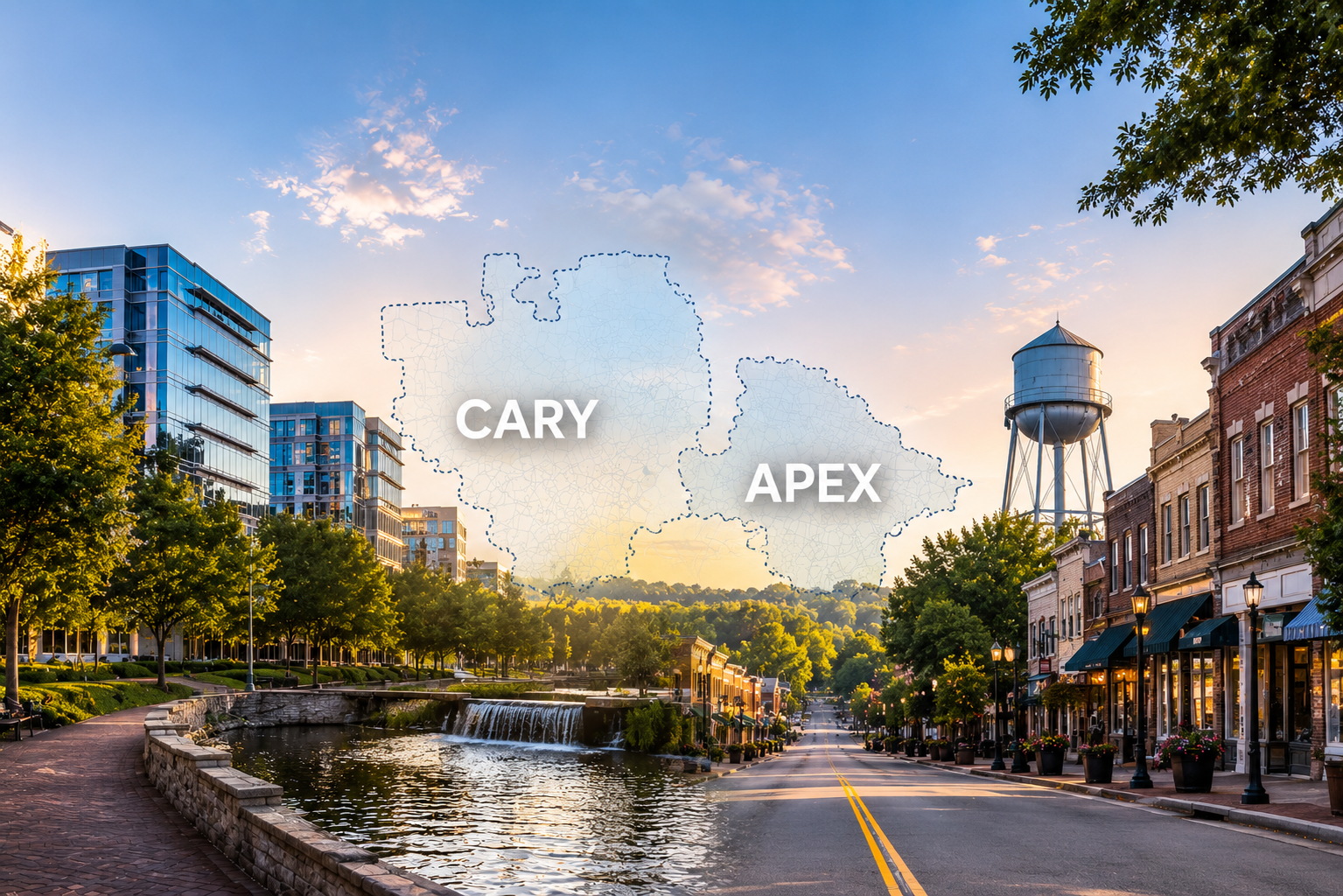
Two of the Triangle’s Most Popular Communities
Cary and Apex are both in Wake County, both served by Wake County Public Schools, and both within reasonable reach of Research Triangle Park. But they attract different buyers — and different neighborhoods within each town can feel surprisingly distinct.
This guide compares the two communities side by side — housing stock, downtown character, commute patterns, and the neighborhoods worth knowing about in each town.
Cary vs Apex at a Glance
| Category | Cary | Apex |
|---|---|---|
| Overall Feel | More established and connected | More residential and neighborhood-focused |
| Housing Stock | Mostly resale homes | More newer homes and new construction |
| New Construction | Limited inventory | Larger selection |
| Mature Trees & Landscaping | Excellent | Varies by neighborhood |
| Shopping & Dining | Multiple established hubs | Growing but more spread out |
| RTP Access | Excellent | Good |
| RDU Airport Access | Excellent | Good |
| Historic Downtown | Modernized downtown district | Traditional small-town character |
| Home Inventory | More limited | More options |
| Best For | Convenience and established neighborhoods | Newer homes and growth opportunities |
The Biggest Difference
Many buyers ultimately describe Cary as feeling more established and connected, while Apex feels newer and more residential.
Cary offers multiple commercial centers, mature landscaping, and decades of built-out infrastructure. Apex offers more new construction, newer neighborhoods, and a community that is still actively growing.
Neither is inherently better — the right choice depends on your priorities.
Another factor that shapes the character of these communities is when much of the housing was built. Much of Apex’s growth occurred after 2000, particularly in western Apex and along the NC-540 corridor. As a result, buyers often find newer floor plans, larger primary suites, higher ceilings, and more modern community amenities.
Cary developed earlier and much of its housing stock was built during the 1980s, 1990s, and early 2000s. While west Cary includes newer communities and some ongoing development, many of Cary’s most established neighborhoods feature mature trees, larger landscaping, and a more settled feel.
About Apex
Apex has grown from a small historic town into one of the Triangle’s most sought-after communities. Known for its award-winning schools, strong neighborhood identity, and expanding selection of new construction, Apex attracts buyers who want newer homes, a quieter residential atmosphere, and access to the Triangle’s growth corridors.
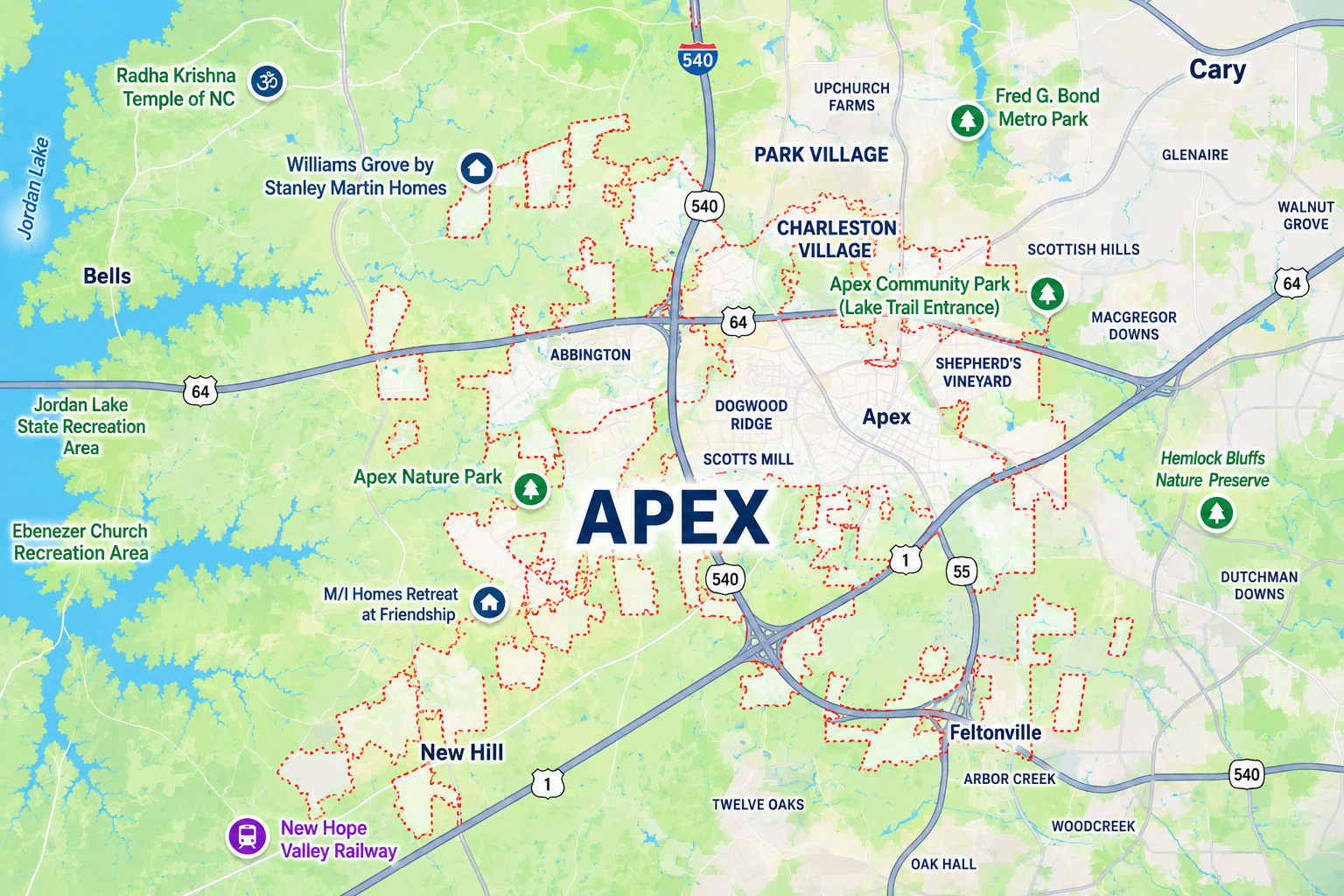
Apex appeals to a wide range of buyers because it offers several very different living environments. Buyers looking for a walkable historic downtown often focus near Salem Street, while those prioritizing newer homes and community amenities frequently look along Friendship Road, Olive Chapel Road, and the NC-540 corridor.
Historic Downtown Apex offers a genuine small-town character with locally owned shops, restaurants, and community events. Further west, Apex’s newest neighborhoods reflect the region’s rapid growth with larger homes, modern amenities, and active development along major corridors.
Shopping & Dining
Apex continues to add retail and dining options, particularly near Beaver Creek Commons and western growth corridors. However, many buyers still find Cary offers a greater concentration of shopping and dining destinations within a shorter drive.
Transportation & Accessibility
Apex is connected to the rest of the Triangle through several major transportation routes.
Major local roads: Apex Peakway, Ten-Ten Road, Olive Chapel Road, Friendship Road, Kelly Road, Salem Street, Beaver Creek Road, Richardson Road, New Hill Road, Green Level West Road, Jenks Road
Not All Apex Feels the Same
One of the biggest mistakes buyers make is assuming all of Apex feels similar.
Downtown Apex
Historic, walkable, locally focused.
Bella Casa & Scotts Mill
Established neighborhoods with mature landscaping and strong community identity.
Salem Village & Haddon Hall
Established communities with convenient access to downtown and shopping.
Sweetwater & Western Apex
New construction, newer amenities, larger homes, and active growth corridors.
Before choosing Apex, it is worth deciding which part of Apex best matches your lifestyle.
About Cary
Cary is one of the most established and connected communities in the Triangle. Its central location between Raleigh, Durham, and Research Triangle Park has made it a long-standing destination for buyers who value convenience, mature neighborhoods, and proximity to major employers and amenities.
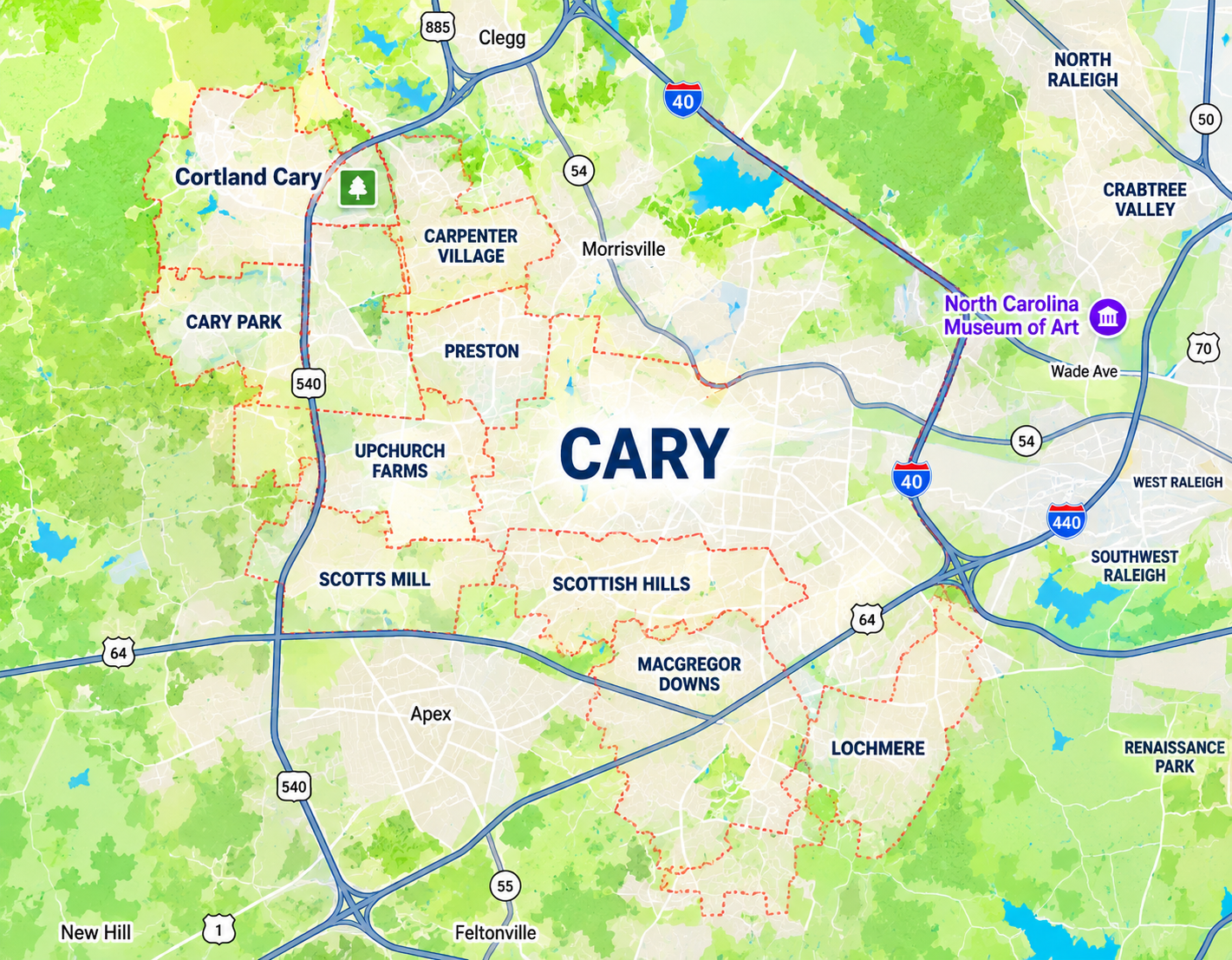
One reason Cary remains one of the Triangle’s most popular communities is that it offers several distinct areas within a single town. Buyers looking for newer homes often gravitate toward west Cary, while those seeking mature neighborhoods and established landscaping frequently focus on central Cary, Preston, or MacGregor Downs.
Many buyers are surprised by how different various parts of Cary feel. Downtown Cary, Preston, MacGregor Downs, West Cary, and eastern Cary each offer a distinct experience. Some buyers are drawn to Cary’s established neighborhoods and mature landscaping, while others choose it for its central location and access to RTP, RDU Airport, Raleigh, and Durham.
Cary offers a wide range of established neighborhoods, multiple shopping and dining destinations, and some of the best access to RTP and RDU Airport in the region. Downtown Cary has been reinvented in recent years, with new restaurants, a performing arts center, and an expanding park district drawing residents back to the town center. Major destinations such as Fenton, Downtown Cary, Crossroads Plaza, and Waverly Place contribute to Cary’s reputation as one of the Triangle’s most convenient communities. Cary’s location also provides convenient access to Morrisville, one of the Triangle’s largest employment centers and a major hub for technology, life sciences, and international employers.
The trade-off is that Cary’s popularity and established infrastructure often come with higher home prices compared to similar homes in parts of Apex.
Shopping & Dining
Cary offers multiple commercial centers throughout town, including Downtown Cary, Fenton, Crossroads Plaza, Waverly Place, and shopping areas near Morrisville. Many residents rarely need to leave Cary for dining, shopping, or entertainment.
Transportation & Accessibility
Cary’s central location provides access to multiple transportation corridors throughout the Triangle.
Major local roads: High House Road, Kildaire Farm Road, Davis Drive, Cary Parkway, Morrisville Parkway, Weston Parkway, Green Level Church Road, Carpenter Fire Station Road, Tryon Road, Walnut Street, Harrison Avenue, Maynard Road
Not All Cary Feels the Same
Just as Apex varies by location, different parts of Cary can feel surprisingly different.
Downtown Cary
Walkable, increasingly urban, and centered around the Cary Downtown Park, restaurants, and local events.
West Cary
Known for newer homes, larger master-planned communities, access to NC-540, and proximity to RTP and Morrisville.
East Cary
Offers convenient access to US-1, I-440, and Raleigh, with a mix of established neighborhoods and redevelopment.
Preston, MacGregor & Central Cary
Known for mature landscaping, golf communities, and some of Cary’s most established neighborhoods.
Popular established neighborhoods include Preston, MacGregor Downs, Lochmere, Cary Park, and Amberly.
Choosing the right part of Cary is often just as important as choosing between Cary and Apex.
Commute & Regional Access
Research Triangle Park (RTP)
Cary often provides shorter access to many RTP employers, particularly from western and northern parts of town. Apex also offers strong RTP access, especially from communities near NC-55 and NC-540.
Raleigh
Both communities provide access to Raleigh, but commute times vary significantly by neighborhood. Eastern Apex and eastern Cary often provide the most convenient access to southeastern Raleigh and Downtown Raleigh.
RDU Airport
Cary generally offers the shortest drive to RDU Airport, while most Apex neighborhoods require additional travel time.
Location Matters
For many buyers, the specific neighborhood matters more than the city itself. A western Apex community near NC-540 may have a very different commute than a home near Downtown Apex. The same is true throughout Cary.
What Buyers Often Notice After Living Here
Statistics only tell part of the story. Many buyers notice practical differences between Cary and Apex only after spending time in both communities.
Cary
Residents often appreciate:
- Mature landscaping throughout town
- Multiple shopping destinations nearby
- Several established dining and entertainment hubs
- Convenient access to daily services
- A more connected feel between neighborhoods
Apex
Residents often appreciate:
- Newer homes and communities
- Strong neighborhood identity
- A quieter residential atmosphere
- Historic downtown character
- More opportunities to purchase newer construction
Buyers often describe Cary as feeling more polished and visually cohesive, while Apex can feel more varied depending on the neighborhood. Cary’s commercial centers are distributed throughout town, whereas Apex tends to feel more neighborhood-oriented with activity concentrated around Downtown Apex, Beaver Creek, and newer growth corridors.
Cary vs Apex for Different Buyers
Cary May Be Better For
- Frequent RTP commuters
- Buyers who travel often through RDU
- Buyers who value convenience
- Buyers who prefer mature landscaping
- Buyers seeking established neighborhoods
Apex May Be Better For
- New construction buyers
- Buyers wanting newer homes
- Buyers who prefer a quieter residential atmosphere
- Buyers who enjoy historic downtown character
- Buyers looking for more inventory options
My Perspective as a Local Realtor
One thing I often tell buyers is that choosing between Cary and Apex is usually less important than choosing the right neighborhood.
A home in western Apex near NC-540 can provide a completely different lifestyle than a home near Historic Downtown Apex. The same is true in Cary, where west Cary, downtown Cary, Preston, and eastern Cary each offer a different experience.
In my experience, buyers often start by comparing Cary and Apex, but eventually end up comparing specific neighborhoods. A home in west Cary and a home in west Apex may have more in common than two homes located in different parts of the same town.
Many buyers begin their search convinced they want one town and ultimately choose the other after touring neighborhoods in person. That’s why I usually recommend exploring several neighborhoods before making a final decision.
Frequently Asked Questions
Still Deciding Between Cary and Apex?
Many buyers begin their search comparing Cary and Apex but ultimately make their decision after touring specific neighborhoods. If you’re considering Cary, Apex, or both, I can help you compare neighborhoods, commute patterns, new construction opportunities, and resale communities throughout the Triangle.