
Moving from Texas to Raleigh, NC
Is It Worth It?
Compare taxes, housing costs, schools, weather, traffic, and daily life — including the honest tradeoffs — before you make the move.
Free 30-minute consultation · English & Russian
Anna Rukhlina · Real Estate Broker · DASH Carolina
Why Texans Are Moving to Raleigh
Texas has been one of the fastest-growing states in the US for years — drawing relocants from California, New York, and beyond. Now the Triangle is drawing people from Texas. The reasons are different from why people leave CA or NY, but they’re real:
The Tax Tradeoff: The Most Important Section on This Page
This page is different from the California, New York, and New Jersey relocation pages. For Texans, the tax picture is more nuanced.
Texas has no state income tax. North Carolina has a flat 3.99% income tax rate (2026). Moving from Texas to NC means paying income tax that you don’t currently pay. This is real and worth acknowledging honestly.
But Texas has very high property taxes. Texas effective property tax rate averages ~1.24% — among the highest in the US. Wake County combined rates are ~0.84–0.87%. On a home that often costs less than comparable Texas properties.
The net picture
- If you earn a high income and own a modest home in Texas → NC may cost you more overall
- If you own an expensive home in Texas (especially Austin or Dallas) → lower NC property taxes may offset the income tax difference
- If you’re a remote worker moving from an expensive Austin zip code → the housing savings alone often outweigh the income tax addition
This is why a CPA conversation before this move is more important than for most relocations. Consult a licensed tax professional for your specific situation.
NC income tax is scheduled to decrease: 3.49% by 2027, 3.14% by 2030.
Property Taxes: Where NC Often Wins
For many Texas homeowners — especially in Austin and Dallas — property tax is where the Triangle delivers real savings.
- Texas effective property tax rates average ~1.24% — among the highest in the US
- Wake County combined property tax rates (county + city) are ~0.84–0.87%
- Applied to homes that typically cost less than comparable Texas properties — the annual savings can be substantial
General comparison only. Rates vary by municipality in both states. Consult a CPA for your specific situation.
Texas vs Raleigh Area: At a Glance
| Category | Texas | Raleigh Area |
|---|---|---|
| Home prices | Varies widely — Austin significantly higher | Comparable to Dallas/Houston; lower than Austin |
| State income tax | None | 3.99% flat (2026)* |
| Property tax (effective rate) | ~1.24% avg — among highest in US | ~0.84–0.87% (Wake Co. + city)** |
| Sales tax | Up to 8.25% (state + local) | 7.3% (Wake County) |
| Gas | Below national average | Below national average |
| Electricity | Varies — ERCOT grid, volatile pricing | More stable — regulated utility rates |
| Childcare (full-time) | Varies by city | Comparable to Texas metros |
| Average commute | 30–75 min (Austin/Dallas/Houston) | 15–30 min |
* NC income tax scheduled to decrease: 3.49% by 2027, 3.14% by 2030.
** Combined Wake County + city rate. Varies by municipality. Check wake.gov.
Housing: What Your Budget Buys in the Triangle
The comparison depends heavily on which Texas city you’re coming from.
Coming from Austin
Austin housing costs have risen dramatically over the past decade. Many Austin zip codes now rival coastal metros in price. The Triangle offers a comparable tech community and quality of life at a meaningfully lower housing cost for most buyers.
Coming from Dallas / Fort Worth
Dallas housing is more comparable to Triangle pricing. The financial case is less dramatic — the lifestyle and property tax difference often drives the decision more than raw housing cost.
Coming from Houston
Houston has remained more affordable than Austin or Dallas. Triangle pricing is broadly comparable. Property taxes and lifestyle tend to be the primary drivers for Houston relocants.
| Budget level | What it typically buys |
|---|---|
| Mid-range Austin budget | May buy a larger, newer home in a top Triangle community |
| Mid-range Dallas/Houston budget | Broadly comparable options; property taxes likely lower in NC |
| Higher-end Texas budget | Access to custom homes, established neighborhoods, larger lots |
Weather: Texas vs North Carolina
For Texans, this is mostly a story about seasons and summer intensity.
What Texans usually love about NC
- Real fall. Texas doesn’t have this. October in the Triangle is genuinely beautiful.
- Real spring. Dogwoods, green hills, mild temperatures — Texas gets hot too fast.
- Milder summers — NC highs average low-to-mid 90s. Texas regularly exceeds 100°F+ for weeks.
- More rainfall and greener landscapes year-round
- Snow within driving distance (mountains 2.5 hrs) without living in it
What Texans sometimes struggle with
- Humidity. NC summers are humid — different from Texas dry heat in the west, though East Texas and Houston are also humid.
- Pollen. February through May. Often more intense than Texas.
- Winter. NC winters are mild but real — a few snow events per year. Texas (outside the panhandle) rarely gets sustained cold.
What NC doesn’t have
- 100°F+ heat waves for weeks at a time
- ERCOT grid reliability concerns — NC has a regulated utility structure
- Drought conditions affecting daily life
- Hurricane risk at Triangle distances (~150 miles inland)
Traffic: Is Raleigh Better Than Texas?
| Austin | Dallas / Houston | Raleigh Area | |
|---|---|---|---|
| Average commute | 40–75 min | 35–65 min | 15–30 min |
| Highway culture | Yes — car required | Yes — car required | Yes — car required |
The honest answer: Austin traffic has become genuinely bad — comparable to mid-tier coastal cities. Dallas and Houston have notorious congestion on their major freeways. Triangle traffic is growing but remains significantly more manageable than any major Texas metro.
Car required in the Triangle — same as Texas.
Will I Be Bored?
Texans have a rich local culture — BBQ, live music (Austin especially), college football, wide-open spaces, and a strong sense of place. Giving that up is real.
If you’re moving from Austin
Austin has one of the strongest live music scenes in the country. The Triangle’s music scene is real but smaller. What you gain: shorter commutes, lower property taxes, and fall foliage. What you lose: 6th Street, ACL Fest, and the specific Austin energy.
If you’re moving from Dallas
Dallas has world-class dining, arts (Dallas Museum of Art, AT&T Performing Arts Center), and professional sports. The Triangle’s cultural scene is growing but not Dallas-scale. The suburban lifestyle translates well — Cary and Apex feel structurally similar to Plano or Frisco.
If you’re moving from Houston
Houston’s food scene — particularly its international and Vietnamese, Mexican, and Southern diversity — is hard to replicate. The Triangle is growing in food diversity but doesn’t match Houston’s depth. The suburban family lifestyle translates well.
What’s actually here
- Sports: Carolina Hurricanes (NHL), ACC college sports (Duke, UNC, NC State). No NFL in the Triangle — Panthers are in Charlotte (2.5 hrs). College basketball here is a serious cultural force.
- Live music: Durham Performing Arts Center (DPAC) — top-grossing venue nationally. Growing local scene, particularly in Durham.
- Food: James Beard-recognized chefs in Raleigh and Durham. Serious BBQ culture — different from Texas BBQ but its own tradition.
- Outdoors: 100+ miles of greenway trails. Jordan Lake 30 minutes away. Mountains 2.5 hours west, beaches 2.5 hours east.
- Breweries and local culture: Growing craft scene with a distinct NC character.
Texas BBQ vs North Carolina BBQ
This will come up. Address it directly. They are different. Both are legitimate. Neither is wrong.
Texas BBQ
Beef-forward. Brisket. Oak or mesquite smoke. Simple seasoning. The meat is the star.
North Carolina BBQ
Pork-forward. Whole hog or shoulder. Vinegar-based sauce (Eastern NC) or tomato-vinegar (Lexington style). Slow-smoked. A distinct regional tradition.
Most Texans who move to NC find NC BBQ genuinely good — just different. The two traditions coexist. Some Texas-style BBQ spots have opened in the Triangle. You won’t go without. Texans will still say theirs is better. That’s fine.
Texas vs North Carolina Lifestyle
What’s similar
- Friendliness and hospitality
- Outdoor culture
- Faith communities
- College sports passion
- Pride in local identity
What’s different
- Texas has an outsized state identity that NC doesn’t match
- NC has a stronger university culture — three major research universities shape the Triangle
- The Triangle draws a highly educated workforce from across the US and internationally — driven by RTP and three major research universities
The honest answer for the Triangle specifically: Research Triangle Park draws professionals from across the US and internationally. NC State, Duke, and UNC drive a diverse, educated population. Major employers include Apple, Google, Cisco, Red Hat, and Biogen. The result is a wide range of international restaurants, cultural institutions, and professional networks that Texans from major metros tend to find familiar. Outside the Triangle, NC is more rural and more traditionally Southern. The Triangle is its own thing.
The Austin Exodus to the Triangle
Austin attracted massive in-migration from CA, NY, and other high-cost states during 2020–2022. Housing prices spiked. Traffic worsened significantly. Many tech workers and remote employees who moved to Austin are now looking at their next move. The Triangle offers a comparable tech ecosystem centered on RTP, housing that is often more affordable than current Austin prices, lower property taxes, more manageable traffic, and four seasons including a real fall. The income tax difference (Texas zero vs NC 3.99%) is real — but for Austin homeowners with high property tax bills and equity from home appreciation, the full financial picture is often more favorable than it first appears.
Why Dallas Families Consider the Triangle
Dallas and its suburbs (Plano, Frisco, Allen, McKinney) have a suburban lifestyle that translates almost directly to the Triangle. Strong schools, master-planned communities with HOAs, community pools, youth sports — Cary and Apex feel structurally familiar to Frisco or The Woodlands. Lower property taxes and less congestion are real draws. The 3.99% NC income tax replaces $0 for all Texas transplants — worth running the full numbers with a CPA before deciding.
Houston Families: Weather Risk Comparison
Houston is one of the most flood-prone major metros in the US. Harvey (2017) and multiple subsequent flooding events have driven many Houston families to seriously evaluate relocation. The Triangle is approximately 150 miles inland from the NC coast. When hurricanes make landfall on the NC coast, they typically arrive as tropical storms by the time they reach the Triangle — bringing significant rainfall and wind, but not the storm surge, catastrophic flooding, or direct hurricane impacts that Houston experiences.
- No evacuation planning for category 4–5 storms
- Lower flood insurance requirements in most Triangle communities (check FEMA maps for specific addresses)
- More predictable weather events
What NC does have: heavy rain events and occasional flooding in low-lying areas. Always check FEMA flood maps for any specific address you’re considering. For Houston families who have lived through major flood events, the Triangle’s inland location is often cited as a significant quality-of-life factor.
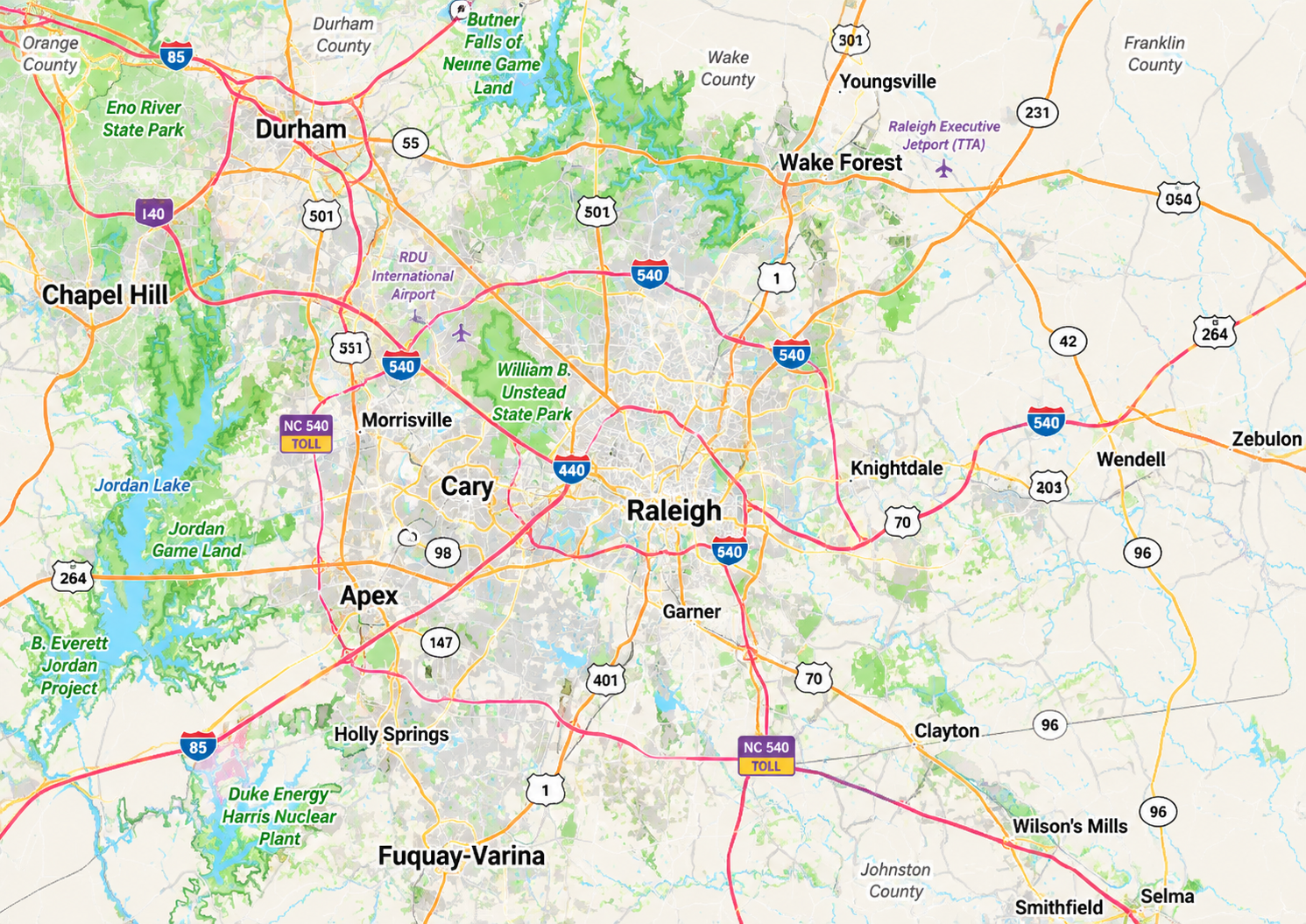
Where Texans Usually Choose to Live
If you know where you’re coming from, this can help narrow it down quickly:
| Coming from | Often consider |
|---|---|
| Austin | Cary, Morrisville, Apex |
| Dallas / Frisco / Plano | Cary, Apex, Holly Springs |
| Houston | Holly Springs, Wake Forest, Fuquay-Varina |
| The Woodlands / Katy / Sugar Land | Wake Forest, North Raleigh |
Details on each area below.
Cary
Typically among the higher-priced markets in the Triangle. Consistently high-performing public schools. Mix of new construction along West Cary / Hwy 55 and established neighborhoods closer to town center. 15–20 min to major employers.
Families, professionals, and buyers who want a well-planned community with strong schools and a central Triangle location. May feel familiar to buyers coming from Plano, Frisco, or other master-planned Texas suburbs.
Higher price point. Some high-demand schools are capped.
Cary Relocation Guide →Apex
Generally slightly more affordable than Cary with comparable school quality. Historic downtown. 20–30 min to Raleigh. Jordan Lake access.
Families, buyers seeking a small-town feel with genuine character.
Growing traffic on Highway 55. Fewer large employers directly nearby.
Apex Relocation Guide →Morrisville
Closest community to major tech employers — 5–12 min commute. Generally strong public schools. More apartments and townhomes than single-family stock.
Those who prioritize employer proximity.
Close to West Cary — often considered alongside it.
Best Neighborhoods Near RTP →Holly Springs
Charming town adjacent to Apex and Fuquay-Varina. 25–35 min to Raleigh. Newer homes at lower price point than Cary. Strong youth sports infrastructure.
Families looking for the best balance of price and quality of life.
Longer commute. Retail and dining developing fast.
North Raleigh
Established neighborhoods with mature trees and larger lots. Close to downtown Raleigh.
Buyers who want resale over new construction. Those seeking character and established landscaping.
School quality varies more by neighborhood. Older homes may need updating.
Wake Forest
More space for the money. Growing fast. 30+ min to downtown Raleigh. Many families consider Wake Forest for its schools, larger homes, and community feel.
Remote workers or buyers not tied to RTP. Those who want maximum space for their budget.
Longest commute. Best for those who rarely need to go to RTP.
Chapel Hill / Carrboro
School district consistently ranks among the top in NC. Walkable town center. University influence. 20–30 min to RTP.
Those who want a walkable downtown and prioritize schools. Good fit for those working in Chapel Hill, Carrboro, or Durham.
Higher price point. Commute to Raleigh and Cary takes more time.
Fuquay-Varina
Most affordable. Quiet family-oriented town with plenty of new construction. 35–45 min to RTP.
Those looking for newer homes, more space, and accessible price.
Longest commutes. Area growing quickly.
Quick Priority Guide
| Your priority | Consider |
|---|---|
| Popular family communities | Apex, Holly Springs, Cary, Chapel Hill, Wake Forest, Fuquay-Varina |
| Strong public schools* | Throughout the Triangle — varies by address |
| New construction | Apex, Fuquay-Varina, Wake Forest, Durham → New Construction in Triangle NC |
| Short commute to major employers | Morrisville, Cary |
| Best value + decent schools | Fuquay-Varina, Wake Forest |
| Larger lots / more land | Wake Forest, Fuquay-Varina, South Raleigh |
| Established neighborhoods / mature trees | North Raleigh, Central Cary, parts of Apex |
| Walkable downtown feel | Chapel Hill, Carrboro, Downtown Raleigh |
* School district assignment depends on your exact address. See school district note below.
Will Lots Feel Smaller?
Texans are used to space — inside and outside the home. This is a real consideration in the Triangle. The honest answer: lot sizes vary significantly by area and community. New construction communities — particularly those built in the last 10–15 years — often have smaller lots than what Texans are used to in suburban Texas.
Where to look for larger lots
- Wake Forest — one of the best options for larger residential lots
- Fuquay-Varina — new construction with more generous lot sizes
- South Raleigh — some established neighborhoods with larger lots
- Parts of Apex — older sections closer to downtown
- North Raleigh resale — established neighborhoods with mature trees
Where lots tend to be smaller
- New construction in Cary, especially West Cary
- Morrisville
- Many HOA communities built post-2010
If lot size is a priority, tell your agent upfront — it will significantly narrow the search.
Texas Master-Planned Communities vs Triangle Communities
Texans from The Woodlands, Frisco, Katy, Round Rock, or Sugar Land know what a master-planned community looks like. The Triangle has equivalents — but they’re not identical.
What’s similar
- HOA communities with common rules and maintained common areas
- Community pools, tennis courts, playgrounds
- Greenway trails within neighborhoods
- Organized youth sports leagues
What’s different
- Triangle communities tend to be smaller in scale than The Woodlands or Frisco
- Less of the “town within a town” mega-development feel
- More variety — established neighborhoods mix with new construction
- HOA fees vary widely ($100–$400/month typically)
Communities that feel most familiar to Texas master-planned buyers: Cary, Apex, and Holly Springs have the highest concentration of planned communities with full amenity packages. Wake Forest and Fuquay-Varina have newer communities with more land.
Schools: What Texas Families Need to Know
- Wake County Public Schools — 48 magnet schools, large system, strong school choice
- Chapel Hill-Carrboro City Schools — consistently ranks among top districts in NC
- School assignment is address-based — research before signing anything
- Some high-demand schools in Cary are at capacity
- Charter schools: free, open enrollment by lottery. Deadlines typically January–February
In North Carolina, schools are assigned by county — not by city name. Two houses on the same street can be in different counties with different school districts. County lines don’t always follow city boundaries: some addresses in Apex, Cary, Holly Springs, Fuquay-Varina, and Wake Forest may fall outside Wake County — into Chatham, Harnett, or Franklin County.
School assignment is address-based — research before signing. Some high-demand schools are capped. Charter schools are free with open enrollment by lottery; deadlines are typically January–February.
Always verify the county and assigned school for your specific address before signing a lease or purchase contract. Use NC School Explorer to check any address.
How Buying a Home in NC Differs From Texas
- Due Diligence Fee: Non-refundable fee paid to seller at contract. Different from Texas earnest money structure.
- Attorney state: NC requires a real estate attorney at closing. Texas uses title companies.
- Speed: 30-day closes are standard.
- HOA communities: Common in NC new construction — similar to Texas master-planned communities.
- New construction volume: High in both states — Texans will feel at home with the volume of new builds.
What a Typical Saturday Looks Like
Saturday in Austin
Check the temperature — already 95°F by 10am. Drive to breakfast (30 min on 183). Avoid the heat until evening. Find a patio bar. Spend $200.
Saturday in Dallas
Drive to the Katy Trail or White Rock Lake. Lunch somewhere in Deep Ellum. Sit in traffic on 75. Complain about the heat.
Saturday in the Raleigh area
Walk to the neighborhood pool or greenway trail. Drive 15 minutes to a farmers market. Head to Jordan Lake for the afternoon. Grill in the backyard. The high is 87°F — manageable.
Different pace. Different scale. Most people who want this Saturday find it quickly.
Travel and Airport Access
- RDU: Direct flights to most major US cities
- Dallas/Houston: ~2.5 hours direct · Austin: ~3 hours direct · Chicago: ~2.5 hours · NYC: ~2 hours
- Easy to get back to Texas for family visits
- Charlotte Douglas (CLT) 2.5 hours away for additional routes
What Former Texans Love — and Miss
What they love
- “Fall. I didn’t know I missed it until I had it again.”
- “My property tax bill is genuinely lower.”
- “The commute is manageable — coming from Austin, this is everything.”
- “The greenways. My kids bike to school.”
- “It still feels like the South — just a different kind.”
- “Mountains are actually close. We go for weekends now.”
- “The food scene surprised me — Durham is legitimately good.”
What they miss
- Texas BBQ. The brisket. The smoke. The simplicity. NC BBQ is good — it’s not the same.
- Texas sports culture. Cowboys, Texans, Longhorns, Aggies — the football religion is different here.
- The space. Texas has a physical scale that NC doesn’t match.
- Texas identity. There is nothing quite like Texas pride.
- The heat. Surprisingly, some Texans miss it.
- Family and friends. Deep Texas roots are real.
Is Moving from Texas to Raleigh Right for You?
You may love it here if
- You’re coming from Austin and housing costs are driving you out
- You work remotely and no longer need to be in a Texas metro
- You want four real seasons — especially fall
- You want lower property taxes
- You want mountains and beaches within a day trip
- You want a smaller-scale city with a real university community
Usually a good fit
- Austin transplants priced out of the market
- Remote workers wanting lower property taxes and four seasons
- Families wanting strong schools and outdoor access
- Tech workers attracted to RTP’s employer base
You may miss Texas if
- Texas BBQ and football culture are central to your identity
- Your family and social roots are deep in Texas
- You love the scale and energy of a major Texas metro
- You need or want to be in a no-income-tax state
May not be a good fit
- People whose identity is deeply tied to Texas
- Anyone making the move primarily for tax reasons — the income tax tradeoff requires careful calculation
- Those who need NFL-city energy and scale
Frequently Asked Questions

Moving from Texas to the Triangle?
I’ve helped Texas families compare Cary, Apex, Holly Springs, Morrisville, and Wake Forest — and navigate the income tax vs property tax tradeoff, NC school assignments, builder contracts, and due diligence along the way.