Best Triangle Areas for Remote Workers
Working remotely changes everything about how you choose where to live. Without a daily commute defining your geography, the decision shifts entirely to lifestyle: How much space do you want? What do you want to walk out the door to? What do your kids need after school? How often do you travel, and how far is the airport?
The Triangle is one of the strongest markets in the country for remote workers. Housing costs significantly less than most coastal metros, fiber internet is widely available, the climate allows outdoor activity most of the year, and the region has enough density to support a genuinely full life — without requiring New York or San Francisco prices to access it.
This guide is built around the questions remote workers actually ask when choosing where to live in the Triangle.
Free 30-minute consultation · English & Russian
Anna Rukhlina · Real Estate Broker · DASH Carolina

Remote Worker Communities at a Glance
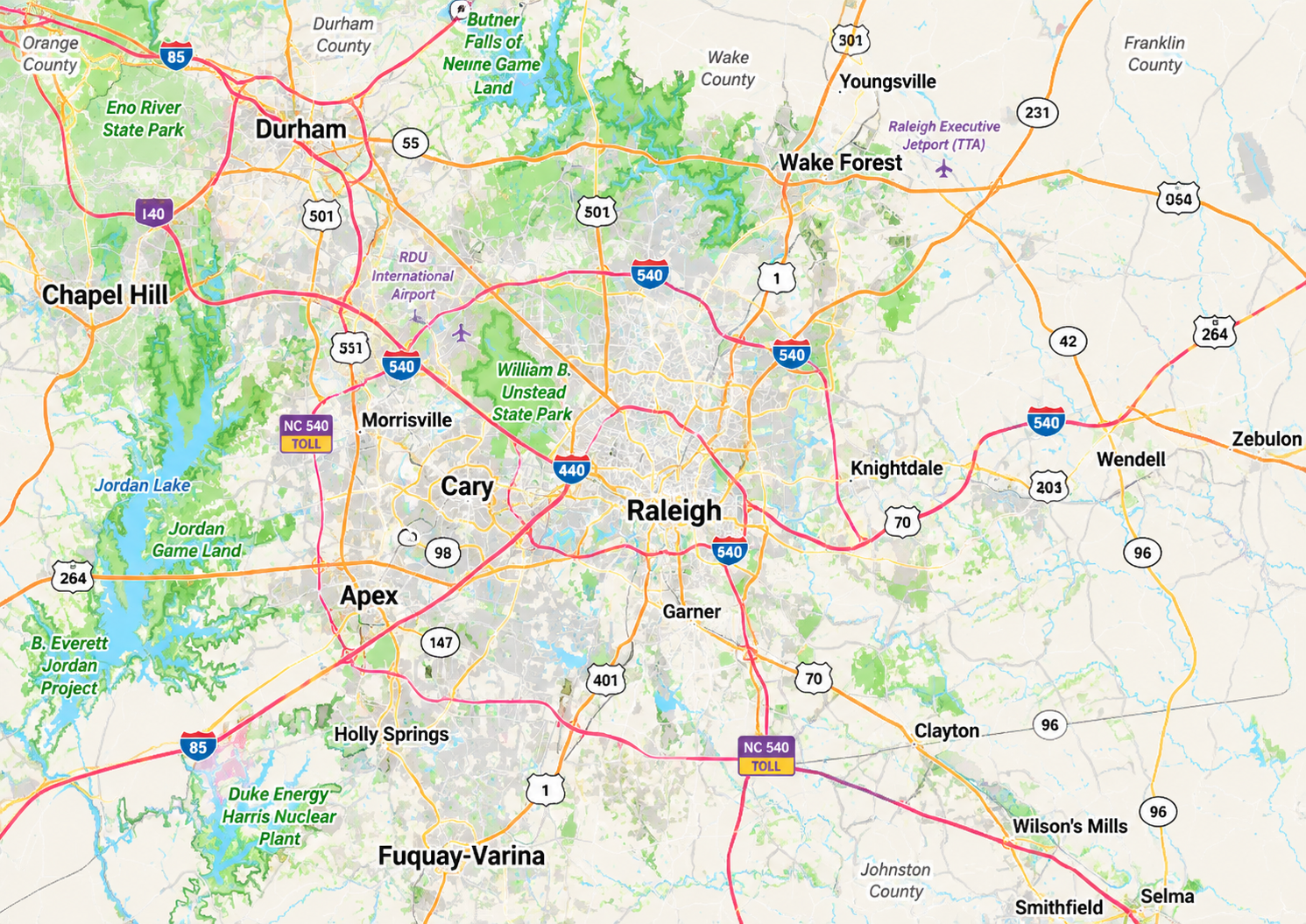
This guide is built around the questions remote workers actually ask when choosing where to live in the Triangle. Use the map below to orient yourself — then work through priorities, the two remote-worker profiles, internet, lifestyle, and budget.
What Remote Workers Actually Look For
Most remote workers don’t lead with “fastest internet” — they lead with lifestyle. The questions that come up most often:
How much space can I actually get?
Most remote workers coming from expensive metros are surprised by what their budget buys here. A $650k budget that gets a 1,400 sqft condo in the Bay Area gets a 3,000 sqft home with a yard in western Wake County.
Will I feel isolated?
Remote work can get lonely. Proximity to coffee shops, coworking spaces, parks, trails, and community events matters more than most buyers admit upfront.
What are the kids going to do?
For families, after-school activities, sports, and weekend programming often matter more than school ratings.
How often do I fly, and how painful is the airport?
RDU is genuinely easy — no traffic, no parking nightmare, short security lines. But proximity still matters if you’re flying every other week.
Will I regret not choosing somewhere more urban?
Buyers coming from dense cities sometimes miss walkability and street-level activity. Some Triangle communities offer this; most don’t.
Start Here: What Matters Most to You?
Larger homes, larger lots, newer construction at lower prices. Real trade-off is distance from urban amenities.
Both offer excellent infrastructure, walkable greenways, retail, dining, and strong community programming.
Active builder inventory, newer communities, modern floor plans.
RDU is 10–20 minutes from most of these communities.
Walkable districts, restaurants, arts scene. Different character from suburban Wake County.
Lowest entry points, largest lots, active new construction. Real distance from urban amenities — which matters less when you’re not commuting.
Two Types of Remote Workers — Which One Are You?
Before getting into specific communities, the most important question is simpler than it sounds:
Do you want to be in the middle of things — or do you want to step away from them?
Remote workers split almost evenly into two camps. Those who want to stay connected to restaurants, trails, events, and activity. And those who are leaving a dense city specifically to get away from it — and want quiet, space, and a slower pace. The Triangle serves both profiles well, but the right community looks completely different depending on which one you are.
“I Want to Be in the Middle of Things”
You want walkable amenities nearby, greenways out the front door, good restaurants for lunch, things going on on weekends, and to feel like you live in an active community rather than a suburb you drive out of.
Cary
The greenway network here is one of the best in the Southeast — over 70 miles of paved trails connecting parks, neighborhoods, and retail. You can work from home and be on a trail in five minutes. Bond Park, Hemlock Bluffs, and the American Tobacco Trail are nearby. Downtown Cary has grown with restaurants, coffee shops, and a park district with regular events. Cary is the most expensive market in Wake County and has limited new construction, but for remote workers who want infrastructure and feel, it delivers.
Budget: $525k–$725k.
Apex
Newer than Cary but building its own identity quickly. Historic downtown Apex has a genuine main street character that sets it apart from purely planned communities. Master-planned neighborhoods come with pools, trails, and community events built in. Growing restaurant and retail options along Salem Street and nearby. For remote workers who want Cary-level amenities at a slightly lower price point with more new construction available, Apex is the strongest alternative.
Budget: $550k–$700k.
Holly Springs
Holly Springs has moved past “bedroom community” status. Ting Park hosts concerts and outdoor events year-round. The downtown area is developing with local dining and coffee options. Strong youth sports infrastructure makes this a natural fit for remote-working families. The feel is community-oriented and growing rather than fully established.
Budget: $475k–$675k.
North Raleigh / North Hills
For remote workers who want walkable retail and dining without fully committing to Downtown Raleigh, North Hills (Midtown Raleigh) is the answer — a walkable mixed-use district with restaurants, retail, and convenient access to both Downtown Raleigh and RTP. North Raleigh more broadly offers mature neighborhoods and a full range of everyday conveniences along the Six Forks Road corridor.
Budget: $400k–$600k.
Downtown Raleigh / Durham
For remote workers who came from dense cities and miss city life: Downtown Raleigh and Durham offer the most genuinely urban experience in the Triangle. Walkable restaurant districts, local coffee shops and coworking, DPAC, arts, and a street-level energy that suburban Wake County doesn’t have. Housing is primarily condos, townhomes, and smaller single-family. Durham is particularly strong for buyers who want independent-restaurant culture and an eclectic neighborhood feel.
Budget varies.
“I Want Space, Quiet, and More Home for the Same Money”
You’re leaving a dense or expensive place specifically because you want out. A large yard, room to breathe, a home office with space, maybe some land. You don’t need to be 10 minutes from a restaurant — you need to be somewhere peaceful.
For this profile, the communities that make the most sense are ones that would be hard sells for RTP commuters — but become genuinely attractive when commute distance is no longer the limiting factor.
Wake Forest
More space per dollar than western Wake County, with a real town center that has enough local restaurants and coffee shops to cover daily needs. Historic Downtown Wake Forest has a walkable core that punches above the town’s size. Larger lots, newer communities, and a noticeably quieter suburban pace. For remote workers with kids, the youth sports infrastructure is solid and growing.
Budget: $450k–$575k.
Fuquay-Varina
The most underestimated community in Wake County for this profile. Larger lots, active new construction, significantly lower prices than Apex or Holly Springs — and a downtown with a growing restaurant and brewery scene that gives it more local character than most people expect. Wake County infrastructure and schools. For the remote worker who wants more home for the money and doesn’t need to be near RTP, Fuquay-Varina is hard to beat.
Budget: $400k–$575k.
South Raleigh — Underrated and Often Overlooked
South Raleigh doesn’t come up in most relocation conversations, which is exactly why it’s worth mentioning here. For remote workers who want to stay within Raleigh city limits at significantly lower prices than North Raleigh — with outdoor access built in — the south side of the city is a real option.
Georgia Landing sits near Lake Wheeler Road in southwest Raleigh. Established neighborhood character, more lot size than you’d find further north, and Lake Wheeler Park is essentially in the backyard — a 600+ acre reservoir with boating, fishing, and a campground that feels worlds away from suburban sprawl.
Lake Wheeler area communities along the Lake Wheeler Road corridor offer a similar profile: proximity to the lake and greenspace, lower prices, and easy access to Downtown Raleigh (15–20 minutes) without the price premium of North Raleigh or Midtown.
Adams Point is another south Raleigh community worth researching for buyers in this profile — established neighborhood, larger lots, and the same lake/outdoor proximity.
The honest trade-off: retail and amenity density is lower in South Raleigh than North Raleigh. You’re not walking to a Whole Foods. But for a remote worker who wants a real yard, outdoor recreation access, a manageable price, and the option to hop to Downtown Raleigh when they want it — this part of the city makes more sense than most buyers realize.
Knightdale
East Triangle, growing fast, and genuinely undervalued. Knightdale is 15–20 minutes from Downtown Raleigh — closer than Wake Forest — but at significantly lower price points. New construction is active. For remote workers who want suburban space and easy access to Raleigh when they want it, Knightdale is worth serious consideration.
Budget: $350k–$500k.
Clayton
Maximum home for the budget. New construction is active, lots are larger, and prices are among the lowest in the region for new builds. Johnston County taxes are lower than Wake County. The real trade-off: you are 40+ minutes from most Triangle amenities, and the kids’ after-school activity ecosystem is thinner than western Wake County. For remote workers whose lifestyle genuinely doesn’t require frequent access to the Triangle core, Clayton delivers exceptional value.
Budget: $325k–$450k.
Zebulon
Similar profile to Clayton but slightly further east. Very active new construction, some of the largest lots available at the lowest prices in the region. For buyers who want a genuinely quiet, semi-rural feel with a new home, Zebulon works. The trade-off is real distance from everything.
Budget: $300k–$425k.
Pittsboro (Chatham County)
The most overlooked option for remote workers who want space, nature, and a different pace entirely. Pittsboro sits near Jordan Lake in Chatham County — 30–35 minutes from Cary and RTP, but a completely different atmosphere. Semi-rural character, land available, and Chatham Park (one of the largest planned community developments in NC history) is bringing new construction and infrastructure to the area. Chatham County schools are separate from Wake County — worth researching if schools matter. For remote workers who prioritize outdoor access and a quieter lifestyle over urban proximity, Pittsboro deserves a serious look.
Budget: varies, generally lower than Wake County for comparable land/home.
Internet & Connectivity
Reliable fast internet is non-negotiable for remote workers. The Triangle is generally well-served:
- AT&T Fiber — available across most of Cary, Apex, Morrisville, North Raleigh, and many other communities. Gigabit speeds.
- Google Fiber — available in parts of the Triangle. Worth checking at the specific address.
- Spectrum — cable internet, widely available as a fallback option throughout the region.
- Frontier Fiber — available in select areas.
- Starlink — available across the entire Triangle, including more rural communities further east and south. A strong option for buyers in Clayton, Wendell, Zebulon, or Angier where wired fiber may be less consistent.
Always verify availability at the specific address before purchasing. Coverage by provider can vary significantly block to block.
Life Outside of Work
One of the most consistent surprises for remote workers who relocate to the Triangle: there is more to do than they expected.
Outdoors and Active
The greenway network across Cary, Apex, and Raleigh is one of the best in the region — hundreds of miles of paved and unpaved trails connecting parks, neighborhoods, and greenspaces. Bond Park (Cary), White Oak Creek Greenway, and the American Tobacco Trail are popular year-round.
Jordan Lake State Recreation Area — 30 minutes from most of western Wake County. Boating, fishing, camping, swimming, and hiking on a large reservoir. A genuine outdoor destination that Triangle residents use regularly, not just once.
Falls Lake — north of Raleigh, popular for kayaking, hiking the Mountains-to-Sea Trail, and swimming beaches.
Day trips: The Blue Ridge Parkway and Asheville are 3–4 hours west. The Outer Banks, Wrightsville Beach, and other NC coastal destinations are 2.5–3 hours east. Driving distance to both mountains and coast from the same home is a genuine lifestyle advantage.
Food, Dining, and Social Life
Downtown Raleigh has grown substantially over the past decade — a walkable restaurant and bar district, local coffee shops, rooftop venues, and a legitimate food scene. Durham has arguably the Triangle’s strongest independent dining culture: the American Tobacco Historic District, vibrant local breweries, and a dense concentration of well-regarded restaurants. Downtown Cary and Downtown Wake Forest both have growing local dining scenes that make evening plans possible without driving to Raleigh.
Events and Entertainment
DPAC (Durham Performing Arts Center) consistently ranks among the top-grossing theaters in North America. Broadway tours, major concerts, comedy, and headliners — the calendar is genuinely strong year-round.
PNC Arena hosts the Carolina Hurricanes (NHL) and major concerts. For buyers coming from hockey markets, the Canes have a devoted following.
NC State, Duke, and UNC provide year-round college sports at a high level — football, basketball, baseball, and more. College sports culture in the Triangle is real and active.
Coworking and Coffee Shops
For remote workers who need to get out of the house, the Triangle has a growing coworking ecosystem: HQ Raleigh, Triangle Cowork, several WeWork locations in Raleigh and Durham, and dozens of coffee shops suitable for working. Cary and Apex have the highest concentration of options in suburban Wake County.
Kids’ After-School Activities and Sports
For remote-working parents, after-school logistics matter as much as the home itself. The Triangle has strong infrastructure for kids’ activities across most communities.
Youth Sports
- Soccer — extremely well-organized throughout Wake County. Capital Area Soccer League (CASL) is one of the largest youth soccer organizations in the country and operates across the region. Recreational and travel leagues are both available starting as young as U5.
- Swimming — club swimming is competitive and widespread. Neighborhood pools with summer swim teams are common in Cary, Apex, and Holly Springs. YMCA swim teams operate across multiple locations.
- Baseball and softball — active recreational and travel leagues across Wake County communities.
- Lacrosse and flag football — growing programs, especially in Cary and Apex.
- Basketball — YMCA leagues, recreational programs, and AAU travel teams all operate across the Triangle.
Individual and Studio Activities
- Gymnastics — multiple well-established gyms in Cary, Apex, and Holly Springs. Thinner options further east in Clayton or Wendell.
- Dance — high concentration of studios in western Wake County. Ballet, hip-hop, competitive dance all represented.
- Martial arts — studios throughout the Triangle across most communities.
- Music lessons — private studios, community music schools, and university-affiliated programs are widely available, especially near Chapel Hill, Durham, and Raleigh.
- Theater and performing arts — community theater programs, school-based theater, and private acting studios. Durham and Chapel Hill have particularly strong arts programming for kids.
STEM and Academic Programs
- Robotics — competitive FLL and FRC teams are active in many Wake County middle and high schools. Private robotics clubs and STEM programs operate in Cary and Apex.
- Coding and technology — private camps, Code Ninjas locations, and after-school programs throughout the region.
- Summer camps — the Triangle has a large and diverse camp ecosystem: YMCA camps, specialty sports camps, arts camps, academic enrichment, and day camps throughout the summer. Planning typically starts in January for popular programs.
Where the Best Selection Is
The broadest range of after-school activities is concentrated in Cary, Apex, and Holly Springs — a combination of population density and family-oriented community infrastructure. North Raleigh and Wake Forest are strong second options. Further east in Clayton, Wendell, and Zebulon, programs exist but require more driving to access the full range.
Budget: What Your Money Buys
For remote workers from expensive markets, the Triangle’s price-to-space ratio is often the deciding factor.
| Area | Typical SFH Range | What You Get |
|---|---|---|
| Cary | $525k – $725k | Established neighborhood, mature trees, greenway access, 2,000–3,000 sqft |
| Apex | $550k – $700k | Newer construction, community amenities, 2,400–3,200 sqft |
| Holly Springs | $475k – $675k | Newer homes, growing community, 2,200–3,000 sqft |
| Wake Forest | $450k – $575k | More lot size and square footage, newer builds, 2,400–3,200 sqft |
| Fuquay-Varina | $400k – $575k | Large lots, new construction, 2,200–3,000 sqft |
| Clayton | $325k – $450k | Maximum space, newer inventory, 1,900–2,800 sqft |
Based on MLS data, single-family homes. Ranges represent core market — outliers above and below exist in all communities.
Common Remote Worker Regrets
These come up consistently from buyers who’ve made the move and are reflecting on what they’d do differently.
Buying too far from amenities.
Maximum square footage in Clayton or Zebulon is real. But so is driving 40 minutes every time you want a decent restaurant, a gymnastics class, or a Target. For daily-life logistics, proximity to amenities compounds over time.
Underestimating airport trips.
“I only travel quarterly” becomes 8 round trips a year. When your nearest airport is 45 minutes away instead of 15, that adds up. RDU proximity matters more than most remote workers budget for upfront.
Choosing square footage over lifestyle.
A 3,800 sqft home in a community with no walkable amenities, no trail access, and a 45-minute drive to everything sounds great until you’re living in it six months in. Lifestyle fit matters as much as home size.
Assuming all internet coverage is the same.
Fiber availability varies significantly block to block. Buyers have moved into a neighborhood expecting AT&T Fiber and discovered only cable or DSL is available at their specific address. Always verify before closing, not after.
Ignoring after-school logistics.
Remote-working parents underestimate how much of their daily schedule is driven by kids’ activities — pickup, dropoff, practice times. If the gymnastics gym is 35 minutes away and practice is at 4pm, that shapes your entire afternoon regardless of where your desk is.
Skipping the neighborhood visit.
Virtual tours show the house. They don’t show the neighborhood at 6pm on a Tuesday, the traffic on the main road, or whether there are any other kids on the street. If at all possible, spend time in the actual neighborhood before committing.
Trade-Offs for Remote Workers
Cary
- Best greenway access, most walkable suburban feel, RDU proximity
- Strong resale, mature infrastructure
- Higher prices, limited new construction, smaller lot sizes
Apex
- New construction inventory, growing amenities, community feel
- Comparable greenway access to Cary, easier on the budget
- Less established feel in newer sections
- Commute to RDU slightly longer
Wake Forest
- Most space per dollar, larger lots, newer communities
- Growing local amenities, real town center
- Further from RDU, Durham, and southern Wake County activities
- US-1 congestion is a factor when you do need to travel
Fuquay-Varina
- Best value in Wake County, large lots, active builder activity
- Wake County schools and infrastructure
- Furthest from RDU and most Triangle amenities
- Southern portions near Harnett County have different school assignments
Clayton
- Lowest price point, maximum square footage, active new construction
- Real distance from Triangle core — 40+ minutes to most destinations
- Thinner after-school activity options for kids
Frequently Asked Questions
Not Sure Which Triangle Community Fits Your Remote Life?
A 30-minute conversation can narrow the field to the 2–3 areas worth your time — based on space, amenities, internet, kids’ activities, and airport access.
Anna Rukhlina · Real Estate Broker · DASH Carolina · 919-332-6256 · Free 30-minute relocation consultations — English & Russian. Serving Cary, Apex, Holly Springs, Wake Forest, Fuquay-Varina, Raleigh, Morrisville, and the Triangle.