Best Places to Live in the Triangle, NC
The Research Triangle — encompassing Raleigh, Durham, Chapel Hill, and dozens of surrounding communities — has become one of the most sought-after regions in the United States. Whether you’re relocating for work, looking for more space, or simply ready for a different pace of life, the Triangle offers a wide range of communities that suit very different priorities and budgets.
This guide breaks down the most popular areas by lifestyle, budget, location, and housing type — to help you narrow the search before diving into listings.
Free 30-minute consultation · English & Russian
Anna Rukhlina · Real Estate Broker · DASH Carolina
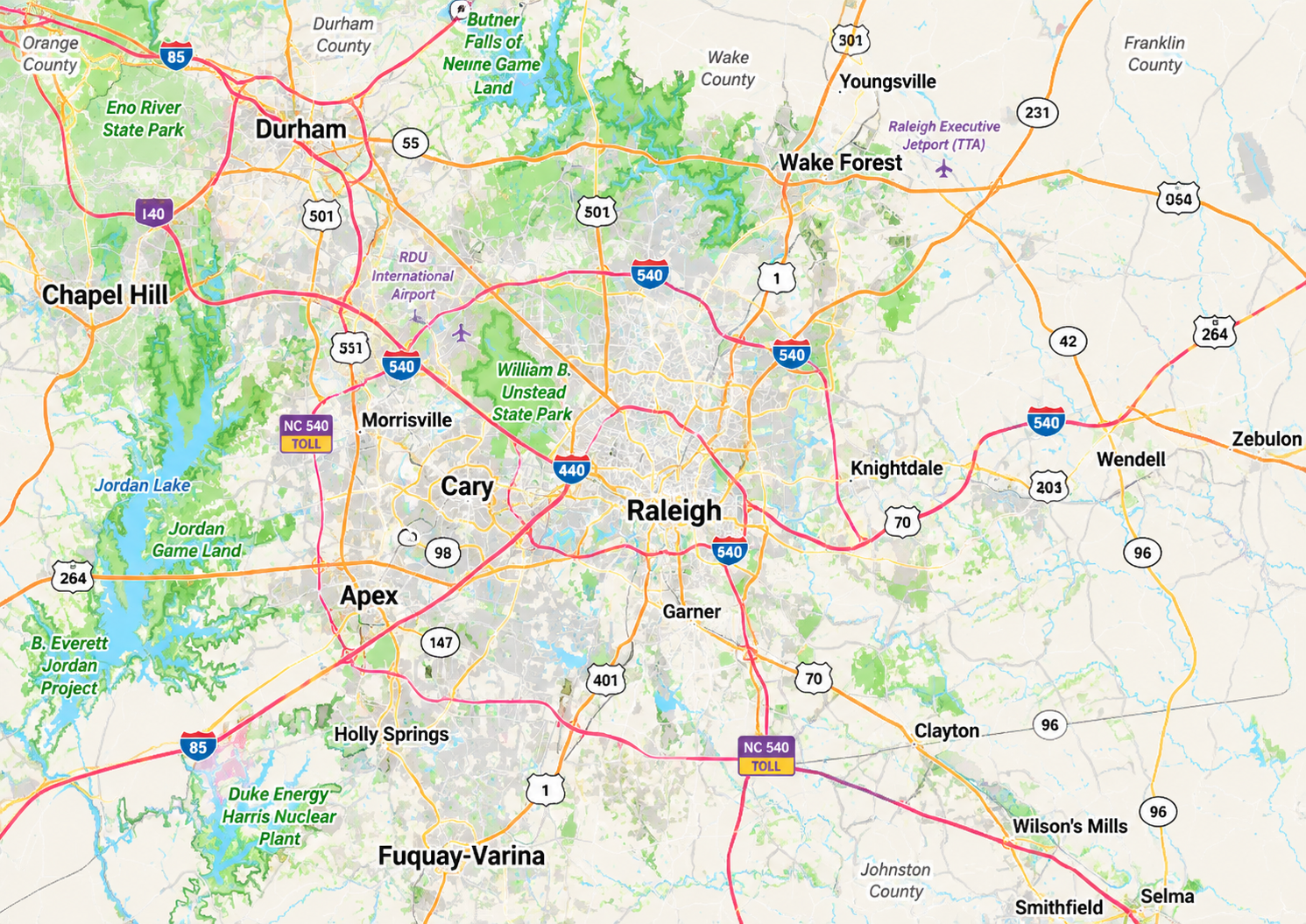
Triangle Communities at a Glance
Use the map below to orient yourself across Wake, Durham, and Orange counties — then work through the sections on this page by commute, budget, and lifestyle.
Quick Overview: How the Triangle Breaks Down
The Triangle spans multiple counties and dozens of distinct communities. Most relocating buyers end up focused on a handful of areas depending on where they work and what they’re looking for:
| Area | Typical Entry Point | Common Buyer Budget |
|---|---|---|
| Cary | ~$450k+ | $550k – $900k |
| Apex | ~$450k+ | $550k – $850k |
| Holly Springs | ~$400k+ | $500k – $750k |
| Raleigh | ~$350k+ | $500k – $850k |
| Wake Forest | ~$375k+ | $450k – $700k |
| Fuquay-Varina | ~$340k+ | $450k – $650k |
| Clayton | ~$295k+ | $350k – $550k |
Based on MLS closed sales data, May 2025–2026, single-family homes. Home prices vary significantly by neighborhood, home size, age, and condition. Budget ranges are intended as general planning estimates rather than market statistics. Verify current pricing with your agent before making a housing decision.
Common Mistakes Relocating Buyers Make
Most regrets from Triangle buyers come from the same handful of patterns — not from choosing a “bad” area, but from choosing the wrong area for their specific situation.
Choosing only by price.
Lower prices in Clayton or Wendell are real, but so is the commute. If you’re driving to RTP five days a week, the math on fuel, time, and wear can quickly offset the savings on the purchase price.
Underestimating peak-hour commutes.
The Triangle looks compact on a map. A 15-mile drive at 8am on I-40 or US-1 is not a 15-minute drive. Always check commute times during rush hour, not on a Sunday afternoon.
Assuming city name = school district.
School assignments in North Carolina are based on the specific property address — not the city or neighborhood name. Portions of Apex and Cary fall in Chatham County, not Wake County. Portions of Fuquay-Varina fall in Harnett County. Always verify the school assigned to any specific address before making a decision.
Choosing new construction without understanding timelines.
Move-in-ready spec homes, homes 60–90 days from completion, and build-from-scratch lots are all “new construction” — but they have very different timelines. If you have a lease ending or a start date at work, timeline matters as much as price.
Overlooking resale in favor of new.
Established neighborhoods in Cary, North Raleigh, and Wake Forest often offer more square footage, larger lots, and mature landscaping at prices comparable to new construction — without the wait.
Skipping the area visit entirely.
Virtual tours work well for understanding a home. They work less well for understanding whether you’ll actually enjoy living in that neighborhood. If at all possible, spend a day or two in the area before committing.
Start Here: Where Do You Need to Be?
Most buyers don’t start with a city. They start with a job, a school, or a budget. Here’s how the shortlist typically looks depending on your situation.
Shortest commutes, strong housing inventory, good long-term resale.
More square footage per dollar, larger lots, newer communities.
Established infrastructure, retail, dining, greenways, airport access.
Durham for proximity and urban options; Cary for those who prefer suburban Wake County with a longer commute.
Chapel Hill and Carrboro for proximity; Durham for more housing options at lower price points.
All offer reasonable commutes at different price points.
Lower entry prices, active new construction, some USDA-eligible areas.
These are general patterns — individual priorities vary. A 30-minute consultation can help map this to your specific situation.
By Lifestyle
Remote Workers
Without a fixed commute, remote workers have the most flexibility in the Triangle. The most popular choices are Apex (newer homes, growing amenities, fiber internet throughout), Fuquay-Varina (more square footage per dollar, larger lots), and Wake Forest (space, newer communities, suburban feel). For those who still want occasional airport access, Cary and Morrisville are within 15–20 minutes of RDU.
Best Triangle Areas for Remote Workers →Commuters to RTP
If Research Triangle Park is your destination, geography narrows the field quickly. Morrisville borders RTP directly — commutes of under 10 minutes are common. Cary and Apex offer 10–25 minute drives with strong housing inventory. Durham and North Raleigh are both within 20–30 minutes for most neighborhoods.
Best Places Near RTP →Commuters to Duke or UNC
Duke University, Duke Health, and UNC Chapel Hill draw a distinct buyer profile. Durham is the natural fit for Duke employees — close, walkable options available, diverse housing stock. Chapel Hill and Carrboro serve UNC proximity well, with established neighborhoods and strong community character. Cary works for buyers who want Wake County schools and can handle a 25–35 minute commute to either campus.
Best Places Near Duke → Best Places Near UNC →First-Time Buyers
Entry-level buyers have more options than most expect. Clayton, Wendell, and Zebulon offer new construction townhomes and single-family homes at significantly lower price points than western Wake County. Fuquay-Varina provides a middle ground — Wake County infrastructure at a lower entry than Apex or Holly Springs. Some areas in these communities also qualify for USDA financing, which eliminates the down payment requirement for eligible buyers.
Best Triangle Areas for First-Time Buyers →Downsizing / Low-Maintenance Living
Buyers looking to downsize or reduce maintenance often prioritize single-story floor plans, smaller lots, and proximity to healthcare and everyday conveniences. Ranch-style homes and single-level floor plans are more common in older established neighborhoods in Cary, Raleigh, and Durham than in newer communities where two-story plans dominate. Townhomes across the Triangle also offer a low-maintenance alternative with HOA-managed exteriors.
Best Triangle Areas for Low-Maintenance Living →By Budget
At this price point, townhomes are available across most of the Triangle — including Cary, Apex, and Holly Springs. For single-family homes, expect older or smaller resale inventory in established areas. New construction townhomes and smaller single-family homes can be found in Knightdale, Garner, Zebulon, Angier, and Clayton — communities further from RTP with lower land costs and active builder activity.
This range opens up meaningfully. Around $400k–$500k, buyers can look at townhomes in Apex, resale single-family homes in Cary, and new construction with more square footage in Knightdale, Zebulon, Angier, Fuquay-Varina, Wake Forest, Clayton, and Rolesville. At $500k–$600k, single-family options in Apex, Holly Springs, and Wake Forest become more realistic, and the selection in western Wake County grows significantly.
Above $600k, the Triangle opens up considerably — newer homes, larger floor plans, better lots, and more options in desirable established communities. Cary, Apex, and Holly Springs are the most active markets in this range. Chapel Hill and premium neighborhoods in North Raleigh and Midtown Raleigh (North Hills) are also primarily $600k+ markets for single-family homes.
By Location
Near Research Triangle Park
RTP is the region’s largest employment center and a major destination for technology, life sciences, and engineering professionals. Communities closest to RTP:
- Morrisville — borders RTP, 5–10 min
- Cary — 10–20 min
- Apex — 15–25 min
- Durham (southwest) — 15–25 min
- North Raleigh — 20–30 min
Near RDU Airport
For frequent travelers, proximity to Raleigh-Durham International Airport matters. Morrisville and Cary are the closest residential communities (10–15 min). Apex and North Raleigh are typically 20–25 minutes.
Near Duke University / Duke Health
- Durham — 5–15 min to most Duke locations
- Chapel Hill — 20–25 min
- Cary — 25–35 min
Near UNC Chapel Hill / UNC Health
- Chapel Hill / Carrboro — on campus or 5–10 min
- Durham — 20–25 min
- Cary — 30–40 min
Near Downtown Raleigh
Downtown Raleigh is a major employment center for state government workers, attorneys, lobbyists, healthcare professionals, and city employees — as well as a draw for buyers who simply want urban proximity without Manhattan prices. Communities with convenient access:
- North Raleigh — 15–25 min depending on neighborhood
- Midtown Raleigh / North Hills — 10–15 min, walkable options available
- Garner — 15–20 min south
- Knightdale — 15–20 min east
- Wake Forest — 25–35 min north
What Is Life Actually Like?
One of the most common questions from buyers relocating from larger coastal metros — often unspoken — is: Will I be bored? The Triangle is not New York or San Francisco. But it is not what many people picture when they think “North Carolina” either.
Restaurants, live music, and events
Downtown Raleigh has grown significantly over the past decade — restaurants, bars, DPAC (a major performing arts venue), the PNC Arena, and a walkable entertainment district. Durham has a strong independent dining and arts scene. North Hills (Midtown Raleigh) is a walkable mixed-use district with high-end dining and retail. Downtown Cary has expanded with restaurants and a park district that hosts regular events.
Outdoors
The Triangle has an extensive greenway network — Cary and Apex in particular have well-developed trail systems. Jordan Lake State Recreation Area (boating, fishing, hiking) is within 20–30 minutes of much of western Wake County. The mountains are 3–4 hours west; the coast is 2–3 hours east. Year-round mild weather makes outdoor activity genuinely practical most of the year.
Culture and university life
Durham and Chapel Hill offer a different character than suburban Wake County — independent bookstores, live music venues, farmers markets, university events, and a more walkable everyday feel. Buyers who want that atmosphere often find western Wake County too suburban.
Family-oriented communities
Cary, Apex, Holly Springs, and Wake Forest have active community programming — youth sports leagues, recreation centers, neighborhood pools, and HOA-organized events. These communities are built for that kind of lifestyle in a way that Downtown Raleigh or Durham are not.
Activities for Kids and Families
For many relocating families, the real question isn’t about schools — it’s about what their kids will do after school and on weekends.
The Triangle has strong infrastructure for youth activities across most communities:
- Youth sports are well-organized in Cary, Apex, Holly Springs, and Wake Forest — soccer, baseball, lacrosse, and basketball leagues are active year-round. Cary has several major recreation facilities including the Cary Tennis Park, Bond Park, and the Cary YMCA.
- Swimming — both competitive and recreational — is widely available. Many neighborhoods in Cary, Apex, and Holly Springs have community pools. Club swim teams operate across the region.
- Gymnastics, dance, and martial arts studios are concentrated in western Wake County. Cary and Apex have the highest density of options; these thin out in more eastern communities like Clayton or Wendell.
- Music, theater, and arts — the Triangle has a strong arts education infrastructure, including private music studios, community theater programs, and programs connected to NC State, UNC, and Duke. Durham and Chapel Hill have particularly strong arts communities.
- Robotics, coding, and STEM programs are active throughout Wake County, with competitive teams in many middle and high schools and private extracurricular programs in Cary and Apex.
Communities with the broadest range of activities within the shortest drive: Cary, Apex, Holly Springs, and North Raleigh. As you move further east or south — Clayton, Wendell, Fuquay-Varina — options exist but require more driving.
Most Common Buyer Dilemmas
Cary vs Apex
Cary: established neighborhoods, mature trees, larger greenway network, slightly higher prices, limited new construction. Apex: more new construction inventory, slightly lower entry, growing community feel, comparable RTP access. Both are strong choices — the decision usually comes down to whether you value established infrastructure or newer homes.
Compare →Apex vs Holly Springs
Apex has more inventory and slightly shorter commute to RTP. Holly Springs has newer communities, more biotech/pharma employer access on the NC-55 corridor, and a similar price range. Holly Springs has more established neighborhoods than many buyers expect — it’s not uniformly new construction.
Compare →Wake Forest vs Fuquay-Varina
Both offer more space per dollar than Cary or Apex. Wake Forest is north of Raleigh with a longer but manageable RTP commute via US-1. Fuquay-Varina is south, with longer RTP commute times but larger lots and active new construction. Wake Forest has a more established town center; Fuquay is growing faster.
Compare →Cary vs Chapel Hill
Very different profiles. Cary: suburban, Wake County, RTP proximity, newer infrastructure. Chapel Hill: university town, Orange County, UNC proximity, established neighborhoods, higher price point, limited new construction. Buyers often choose based on where they work — Duke/UNC pulls toward Chapel Hill, RTP pulls toward Cary.
Trade-Offs: The Most Compared Communities
Every Triangle community has real advantages and real trade-offs. Here’s an honest look at the most commonly considered areas.
Cary
- Mature neighborhoods, extensive greenway network, strong long-term resale
- Closest established community to RTP and RDU
- Limited new construction inventory, higher entry price
- Lot sizes have trended smaller over time
Apex
- Strong new construction inventory, growing amenities, family-oriented communities
- Slightly lower entry than Cary on average
- Less established feel than Cary in newer sections
- Commute to RTP slightly longer than Morrisville or western Cary
Holly Springs
- Newer homes, growing retail and dining, biotech/pharma corridor access
- Strong community feel, newer infrastructure
- Longer commute to RTP than Cary or Apex
- Mix of established and newer stock — not uniformly new
Wake Forest
- More space per dollar, larger lots, newer communities
- Growing day-to-day conveniences already in place
- One main route to Raleigh (US-1) — traffic builds at peak hours
- 30–40 min to RTP is the real number, not the map number
Fuquay-Varina
- Best value for single-family in Wake County, large lots, active new construction
- Wake County schools and infrastructure
- 35–45 min to RTP is a real daily commitment
- Southern areas near Harnett County border have different school assignments
Explore Triangle Cities
Every city in the Triangle has its own character, housing stock, and trade-offs. Explore individual city guides:
Compare Areas Side by Side
Still deciding between two communities? Side-by-side comparisons:
Frequently Asked Questions
Not Sure Which Triangle Community Fits Your Life?
A 30-minute conversation can narrow dozens of options to the 2–3 areas worth your time — based on commute, budget, schools, and lifestyle priorities.