Raleigh vs Charlotte: Which North Carolina City Is Right for You?
For buyers relocating to North Carolina, the choice between Raleigh and Charlotte is one of the most common starting points. Both cities are growing rapidly, offer strong job markets, and attract buyers from across the country and around the world.
But they feel very different in practice — and understanding those differences can help you make a more confident decision before you begin touring homes.
Free 30-minute consultation · English & Russian
Anna Rukhlina · Real Estate Broker · DASH Carolina
Two of North Carolina’s Fastest-Growing Metros
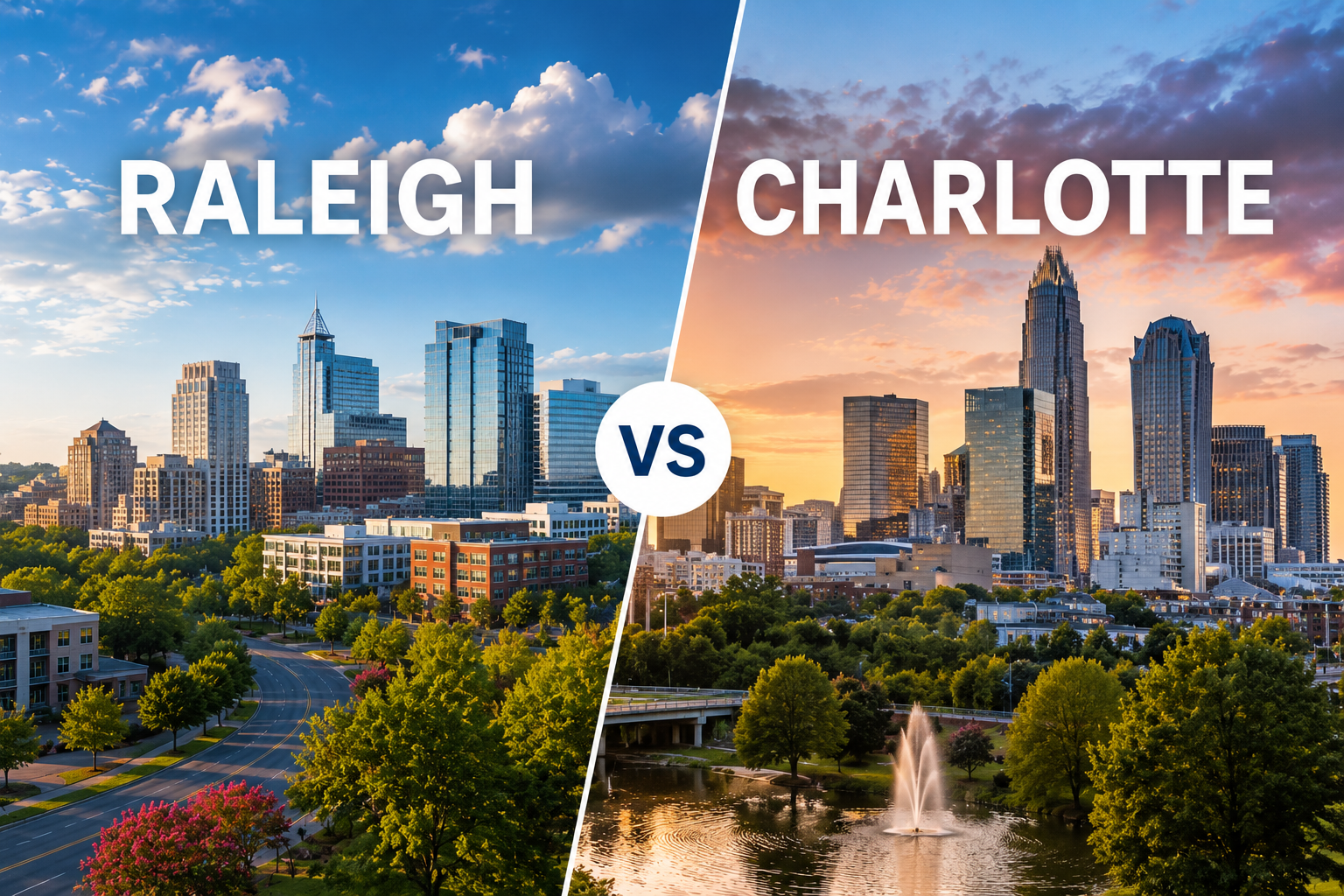
Raleigh and Charlotte are the two largest cities in North Carolina and two of the most popular relocation destinations in the Southeast. Both offer strong economies, diverse housing options, and growing cultural amenities — but they attract different buyers and support different lifestyles.
This guide compares the two metros side by side — employment, schools, commute patterns, housing, and the neighborhoods worth exploring in each market.
Raleigh vs Charlotte at a Glance
| Category | Raleigh | Charlotte |
|---|---|---|
| Overall Feel | University town meets tech hub | Finance and corporate center |
| Major Industries | Technology, life sciences, government, education | Banking, finance, energy, logistics |
| Downtown Character | Growing arts and dining scene | More developed urban core |
| Airport | RDU — regional hub, growing | CLT — major international hub |
| Pro Sports | Carolina Hurricanes (NHL) | Panthers (NFL), Hornets (NBA), Charlotte FC (MLS) |
| Public Schools | Wake County — consistently strong | Charlotte-Mecklenburg — more variable |
| University Presence | NC State, Duke, UNC nearby | UNC Charlotte |
| Cost of Living | Slightly lower on average | Comparable, higher in some areas |
| Suburban Options | Cary, Apex, Morrisville, Holly Springs, Wake Forest | Ballantyne, SouthPark, Huntersville, Davidson, Mooresville |
| Tech Jobs | Excellent | Growing |
| Finance Jobs | Limited | Excellent |
| Traffic | Moderate to heavy | Heavy |
| New Construction | Strong | Strong |
| International Flights | Good | Excellent |
| Best For | Buyers prioritizing schools, tech jobs, and quality of life | Buyers prioritizing urban amenities, finance careers, and airport access |
The Biggest Difference
Many buyers describe Raleigh as feeling like a college town that grew into a major metro — research-driven, community-oriented, and still expanding. Charlotte feels more like an established corporate city, with a stronger urban core and a longer history as a regional business hub.
Raleigh’s growth is closely tied to Research Triangle Park, the universities, and a booming technology and life sciences sector. Charlotte’s growth has been anchored by its banking and finance industry for decades, and its economy has since diversified into energy, logistics, and healthcare.
For buyers focused on schools, outdoor lifestyle, and proximity to university research culture, Raleigh and the surrounding Triangle communities tend to be the stronger fit. For buyers who prioritize urban living, direct international flights, and a more established corporate infrastructure, Charlotte often holds the advantage.
Neither city is inherently better. The right choice depends on where you work, how you live, and what you want from your community.
Day-to-Day Feel
Many buyers describe Raleigh as feeling more community-oriented and suburban, even as the metro continues to grow. Neighborhoods tend to feel quieter, commutes are somewhat more predictable, and the overall pace is a step slower than a major corporate hub.
Charlotte generally feels larger, busier, and more urban. The city has a more developed skyline, denser business districts, and a stronger corporate presence throughout the metro.
For some buyers, that energy is a major advantage. Others prefer the quieter pace commonly found throughout the Triangle.
About Raleigh
Raleigh is the state capital of North Carolina and the center of the Research Triangle, one of the most educated and fastest-growing metro areas in the United States. It sits alongside Durham and Chapel Hill, forming a region anchored by NC State University, Duke University, and the University of North Carolina at Chapel Hill.
That university presence shapes everything about the Raleigh area — from the concentration of research employers and hospital systems to the parks, cultural institutions, and walkable neighborhoods that have grown up around the academic core. Raleigh consistently ranks among the top cities in the country for quality of life, job growth, and livability.
Buyers relocating to Raleigh often notice that the metro feels less like a single city and more like a collection of connected communities — Raleigh, Cary, Apex, Morrisville, Wake Forest, and Holly Springs each with its own character. Many buyers find that their day-to-day life is centered around their suburb rather than downtown Raleigh itself.
Employment
Raleigh’s job market is driven by Research Triangle Park (RTP), one of the largest research and technology campuses in the world. Major employers include IBM, Cisco, Lenovo, SAS, Red Hat, Biogen, and dozens of life sciences and pharmaceutical companies. State government, healthcare, and education round out a diverse economic base that has proven resilient through economic cycles.
For buyers considering Raleigh, proximity to RTP — which sits between Raleigh, Durham, and Chapel Hill — is often one of the most important factors in choosing a neighborhood.
Shopping & Dining
Downtown Raleigh has undergone significant transformation over the past decade, with a growing restaurant scene, the Raleigh Convention Center, the North Carolina Museum of Art, and expanding nightlife corridors along Glenwood South and Fayetteville Street.
Beyond downtown, North Hills has developed into one of the Triangle’s most popular mixed-use destinations, with restaurants, retail, and entertainment options in a walkable suburban setting. The surrounding communities of Cary, Apex, and Morrisville each add their own commercial hubs, including Fenton, Crossroads Plaza, and Waverly Place.
Transportation & Accessibility
Raleigh’s transportation infrastructure is primarily highway-based.
Airport: Raleigh-Durham International Airport (RDU) serves most major domestic destinations and a growing number of international routes.
Notable limitation: Raleigh currently lacks a light rail or commuter rail system. Traffic on I-40 and I-440 can be significant during peak hours, particularly around RTP and the Beltline.
Not All Raleigh Feels the Same
Raleigh covers a large geographic area, and different parts of the metro offer very different living experiences.
Downtown Raleigh
An increasingly urban environment with walkable blocks, restaurants, arts venues, and a growing number of condominiums and apartments.
North Hills & Midtown
One of the Triangle’s most popular urban-suburban districts, with high-end retail, dining, and proximity to some of Raleigh’s most desirable neighborhoods.
North Raleigh
Established suburbs with strong schools, mature neighborhoods, and convenient access to I-540 and northern employment corridors.
South Raleigh & Garner
More affordable options with improving infrastructure and proximity to downtown.
Cary, Apex & Morrisville
Often considered the most competitive suburban markets in the Triangle. Many buyers who search for Raleigh ultimately choose these communities for their schools, newer homes, and access to RTP.
Before committing to Raleigh, it is worth exploring which part of the Triangle best matches your commute, lifestyle, and housing priorities.
About Charlotte
Charlotte is the largest city in North Carolina and one of the fastest-growing cities in the American South. It serves as the headquarters for Bank of America and a major hub for Wells Fargo, making it one of the country’s top banking and financial services centers. Over the past two decades, Charlotte has diversified into energy, healthcare, logistics, and technology.
Charlotte’s urban core — known as Uptown — is more developed than downtown Raleigh and offers a denser, more walkable experience. The city has invested significantly in light rail, stadium infrastructure, and public spaces, giving it a more metropolitan feel.
For buyers who want immediate access to major-league professional sports, a busier international airport, and a more established city infrastructure, Charlotte often feels more ready. For buyers who value quieter suburban living, strong public schools, and proximity to research-driven employment, many find the Raleigh area more compelling.
Employment
Charlotte’s economy is anchored by financial services but has expanded into energy (Duke Energy), logistics (Amazon, FedEx regional hubs), healthcare (Atrium Health, Novant Health), and a growing technology sector. The presence of major corporate headquarters means Charlotte attracts more buyers with traditional corporate career tracks.
UNC Charlotte has been growing rapidly, and its research programs are beginning to shape a small but expanding innovation corridor on the city’s northeastern side.
Shopping & Dining
Charlotte offers a more developed retail and dining landscape, particularly in SouthPark, Uptown, and the NoDa (North Davidson) arts district. Ballantyne and Huntersville provide suburban commercial hubs with national and regional dining options.
The city also hosts more large-scale entertainment venues, including Bank of America Stadium, Spectrum Center, and Charlotte Motor Speedway. For buyers who attend professional sporting events or major concerts regularly, Charlotte’s options are broader.
Transportation & Accessibility
Charlotte has invested more heavily in public transportation infrastructure than Raleigh.
Airport: Charlotte Douglas International Airport (CLT) is one of the busiest airports in the United States and a major American Airlines hub, offering direct international routes that RDU does not.
Light Rail: The LYNX Blue Line connects several neighborhoods to Uptown and is being expanded. For buyers who prioritize public transit, Charlotte currently has a meaningful advantage over Raleigh.
Not All Charlotte Feels the Same
Like Raleigh, Charlotte varies significantly by location.
Uptown Charlotte
The urban core — denser, more walkable, home to corporate offices, sports venues, and a growing residential population.
SouthPark
One of Charlotte’s most established and affluent areas, with high-end retail, restaurants, and proximity to major employers.
NoDa & Plaza Midwood
Charlotte’s arts and creative districts, popular with younger buyers and those seeking a more urban neighborhood feel.
Ballantyne & South Charlotte
Known for newer suburban development, family-oriented neighborhoods, and strong private school options.
Huntersville, Cornelius & Davidson
Popular lake communities north of Charlotte along Lake Norman, offering a more suburban or small-town character with convenient access to the city.
Matthews & Mint Hill
Established southeastern suburbs with more affordable options and a quieter feel.
Commute & Regional Access
Research Triangle Park (RTP)
RTP is accessible from across the Triangle, but buyers living in Cary, Morrisville, Apex, and western Durham typically enjoy the shortest commutes. For buyers whose primary employer is in RTP, the Raleigh metro holds a clear geographic advantage over Charlotte.
Charlotte’s Corporate Core
Most of Charlotte’s largest employers are concentrated in Uptown and SouthPark. Buyers who live in south Charlotte, Ballantyne, or Huntersville typically find their commutes manageable, though traffic on I-77 can be challenging during peak hours.
Airport Access
Charlotte Douglas International Airport (CLT) is one of the country’s top 10 busiest airports and offers significantly more direct flight options than RDU, including direct international routes to Europe and Latin America. For buyers who travel frequently for work or have family abroad, this can be a meaningful practical difference.
RDU continues to add routes and has improved meaningfully in recent years, but for high-frequency travelers, CLT still offers more flexibility.
Location Matters
Both metros are large enough that neighborhood location can matter as much as city choice. A buyer living in Morrisville may have a dramatically shorter commute to RTP than a buyer in North Raleigh. A buyer in Ballantyne may find CLT significantly faster than a buyer in Huntersville.
Before choosing between cities, it is worth mapping out where you will spend most of your time — not just which city name you prefer.
Housing & New Construction
Raleigh’s suburban growth has been concentrated in communities such as Cary, Apex, Holly Springs, Fuquay-Varina, Wake Forest, and Rolesville. Buyers often find a mix of established neighborhoods built in the 1980s and 1990s alongside newer master-planned communities that have developed along the NC-540 corridor and beyond.
Charlotte also offers significant new construction, particularly in Huntersville, Concord, Mooresville, and parts of South Charlotte. Development patterns differ considerably by corridor and suburb, and buyers should research specific communities rather than assuming uniform conditions across either metro.
For buyers seeking newer homes, both metros provide strong options. The key difference is usually which specific communities align with your commute, school preferences, and lifestyle priorities — not which city offers more construction overall.
What Buyers Often Notice After Living Here
Raleigh
Residents often appreciate:
- A strong sense of community in suburban neighborhoods
- Consistently well-regarded public schools throughout Wake County
- Proximity to universities and their cultural and recreational programming
- A slower pace relative to Charlotte’s urban core
- More opportunities to find newer suburban homes within established master-planned communities
Charlotte
Residents often appreciate:
- A more developed urban experience in Uptown and surrounding neighborhoods
- More direct flight options from CLT
- Professional sports teams and major entertainment events
- A broader range of established corporate employers
- The character and natural setting of the Lake Norman communities
One observation that comes up often is that Raleigh can feel like several smaller communities connected by highways, while Charlotte’s more developed core gives it a stronger sense of being a single city. Buyers who want an urban experience often find Charlotte further along. Buyers who prefer suburban community character often feel more at home in the Triangle.
Raleigh vs Charlotte for Different Buyers
Raleigh May Be the Better Fit For
- Buyers with jobs in tech, life sciences, or government
- Buyers prioritizing public school quality
- Buyers who value outdoor recreation and greenway access
- Buyers relocating to work near Research Triangle Park
- Buyers who prefer a suburban community feel with urban amenities nearby
Charlotte May Be the Better Fit For
- Buyers in banking, finance, or corporate roles
- Buyers who travel internationally and need CLT access
- Buyers who want a more developed urban core
- Buyers who prioritize professional sports and major entertainment
- Buyers considering the Lake Norman lifestyle
My Perspective as a Local Realtor
I work primarily in the Triangle, so my direct expertise is in Raleigh, Cary, Apex, Morrisville, and the surrounding communities. What I can tell you is that most buyers who come to the Triangle do not regret the decision.
The combination of strong public schools, a diverse job market anchored by RTP, and a suburban lifestyle that still offers genuine community character is difficult to find at this price point elsewhere in the country.
That said, Charlotte is a real city with genuine advantages — particularly for buyers in finance or those who travel heavily for work. I always encourage buyers to spend time in both metros before committing to either one.
In my experience, the buyers who struggle the most are those who compare city names instead of specific neighborhoods and commute patterns. A home in west Cary and a home in Ballantyne may have more in common than either has with its own city’s downtown.
What surprises many buyers is that choosing between Raleigh and Charlotte is often easier than choosing between neighborhoods once they arrive. The differences between west Cary, Apex, North Raleigh, Ballantyne, SouthPark, and Huntersville can be just as significant as the differences between the two metros themselves.
If you’re leaning toward the Raleigh area, I’d be glad to help you understand the specific communities, school zones, and neighborhoods that might best match your priorities.
Frequently Asked Questions
Considering a Move to the Raleigh Area?
Many buyers who begin by comparing Raleigh and Charlotte ultimately make their decision after touring specific neighborhoods and mapping their daily routines. If you’re exploring the Raleigh area — including Cary, Apex, Morrisville, Holly Springs, or other Triangle communities — I can help you understand the neighborhoods, school zones, commute patterns, and new construction opportunities that match your goals.