
Moving from Virginia to North Carolina
Is It Worth It?
Compare housing, taxes, schools, traffic, weather, and daily life — including the honest tradeoffs — before you make the move.
Free 30-minute consultation · English & Russian
Anna Rukhlina · Real Estate Broker · DASH Carolina
Why Virginians Are Moving to North Carolina
Virginia is a strong state with a lot going for it — Northern Virginia’s economy, Richmond’s character, Hampton Roads’ military community, Charlottesville’s university culture. Most people who leave aren’t escaping something broken. They’re choosing something different.
The reasons that come up most often:
Virginia is geographically the Triangle’s closest large-state neighbor to the north. The move is shorter, culturally closer, and often less jarring than relocations from Texas, Florida, or California. Former Virginians tend to settle in quickly.
Taxes: A Roughly Neutral-to-Favorable Picture
Virginia’s income tax ranges from 2% to 5.75% — with the top bracket starting at a relatively low income threshold. Unlike Maryland, Virginia has no county income tax on top of the state rate. North Carolina’s flat 3.99% rate (2026) is lower than Virginia’s top bracket, making the move tax-favorable for most mid-to-high earners.
For lower earners still in Virginia’s 2–4% brackets, the difference is minimal in either direction.
Property taxes depend heavily on which part of Virginia you’re leaving:
- Fairfax County: ~1.05% effective rate
- Arlington County: ~0.95%
- Loudoun County: ~0.83%
- Richmond City: ~1.2%
- Virginia Beach / Chesapeake: ~0.95–1.0%
Wake County combined rates run ~0.84–0.87% — lower than most Northern Virginia localities and Richmond, broadly comparable to Loudoun. On a home that often costs less than comparable Virginia properties, the annual difference can be meaningful.
Vehicle registration: Virginia’s personal property tax on vehicles is significant — most Virginia localities charge an annual fee based on vehicle value that can run several hundred dollars per year. NC charges an annual vehicle property tax via the DMV plus a flat registration fee — typically much lower than Virginia’s value-based tax for most households.
NC income tax is scheduled to decrease: 3.49% by 2027, 3.14% by 2030. Consult a licensed CPA for your specific situation.
Virginia vs Raleigh Area: At a Glance
| Category | Virginia | Raleigh Area |
|---|---|---|
| Home prices | Varies — NoVA very high; Richmond/Hampton Roads moderate | Generally lower than NoVA; comparable to Richmond/Hampton Roads |
| State income tax | 2–5.75% (no county income tax) | 3.99% flat* |
| Property tax (effective rate) | 0.83–1.2% depending on locality | ~0.84–0.87% (Wake Co. + city)** |
| Vehicle personal property tax | Annual — based on vehicle value | Annual property tax via DMV + flat registration fee — typically much lower |
| Sales tax | 5.3% state + local (4.3–6% total) | 7.3% (Wake County) |
| Gas | Near national average | Below national average |
| Average commute | 45–75 min (NoVA) / 25–40 min (Richmond/Hampton Roads) | 15–30 min |
* NC income tax scheduled to decrease: 3.49% by 2027, 3.14% by 2030.
** Combined Wake County + city rate. Varies by municipality. Check wake.gov.
What Your Virginia Budget Buys in the Triangle
Coming from Northern Virginia (Fairfax, Arlington, Loudoun, Prince William)
NoVA is one of the most expensive housing markets in the Mid-Atlantic. The Triangle typically offers significantly more square footage, newer construction, and larger lots for a comparable or lower purchase price. The shift is often dramatic for buyers coming from Fairfax County or Arlington.
Coming from Richmond
Richmond is more moderately priced and has appreciated steadily. Triangle pricing is broadly comparable in many neighborhoods — the financial case centers more on income tax savings, commute improvement, and the Triangle’s growing job market than on a dramatic housing cost gap.
Coming from Hampton Roads / Virginia Beach
Hampton Roads pricing is moderate and broadly comparable to Triangle markets. Insurance costs and the proximity to employer bases (particularly for those transitioning out of military careers) often drive the decision more than raw housing cost.
Coming from Charlottesville
Charlottesville has become surprisingly expensive for its size. Triangle pricing is generally comparable or lower, with a much broader range of communities and new construction options.
| Budget level | What it typically buys |
|---|---|
| Mid-range NoVA budget | Often buys a significantly larger, newer home in a top Triangle community |
| Mid-range Richmond/Hampton Roads budget | Broadly comparable; lower vehicle taxes and often lower property taxes |
| Higher-end Virginia budget | Access to custom homes, larger lots, established neighborhoods |
Where Virginia Residents Usually Choose to Live
If you know where you’re coming from, this helps narrow it down:
| Coming from | Often consider |
|---|---|
| Fairfax County / Tysons / Reston | Cary, Morrisville, Apex |
| Arlington / Alexandria | Cary, Apex, Chapel Hill |
| Loudoun County / Ashburn / Leesburg | Apex, Holly Springs, Cary |
| Prince William / Manassas | Holly Springs, Wake Forest, Fuquay-Varina |
| Richmond metro | North Raleigh, Apex, Wake Forest, Garner |
| Hampton Roads / Virginia Beach / Chesapeake | Holly Springs, Fuquay-Varina, Wake Forest, Garner |
| Suffolk / Portsmouth / outer Hampton Roads | Fuquay-Varina, Wendell, Clayton |
| Charlottesville | Chapel Hill, Apex, Cary |
Virginia areas and their Triangle counterparts — not exact equivalents, but communities that tend to resonate with buyers from each area:
| Virginia area | Often appeals to buyers from |
|---|---|
| Cary | Reston, Herndon, Fairfax City, Short Pump (Richmond) |
| Cary / Morrisville | Tysons / McLean corridor |
| Apex | Ashburn, South Riding, Midlothian |
| North Raleigh | Chantilly, Burke, outer Fairfax County |
| Chapel Hill | Charlottesville, Alexandria |
| Wake Forest | Prince William County, Stafford, outer Richmond suburbs |
| Holly Springs | Loudoun County outer suburbs |
| Garner | Richmond Southside, Chesapeake, Portsmouth |
| Knightdale | Richmond East End, outer Hampton Roads |
| Clayton | Virginia Beach, Suffolk, Williamsburg area |
| Wendell | Buyers prioritizing value; Hampton Roads outer suburbs |
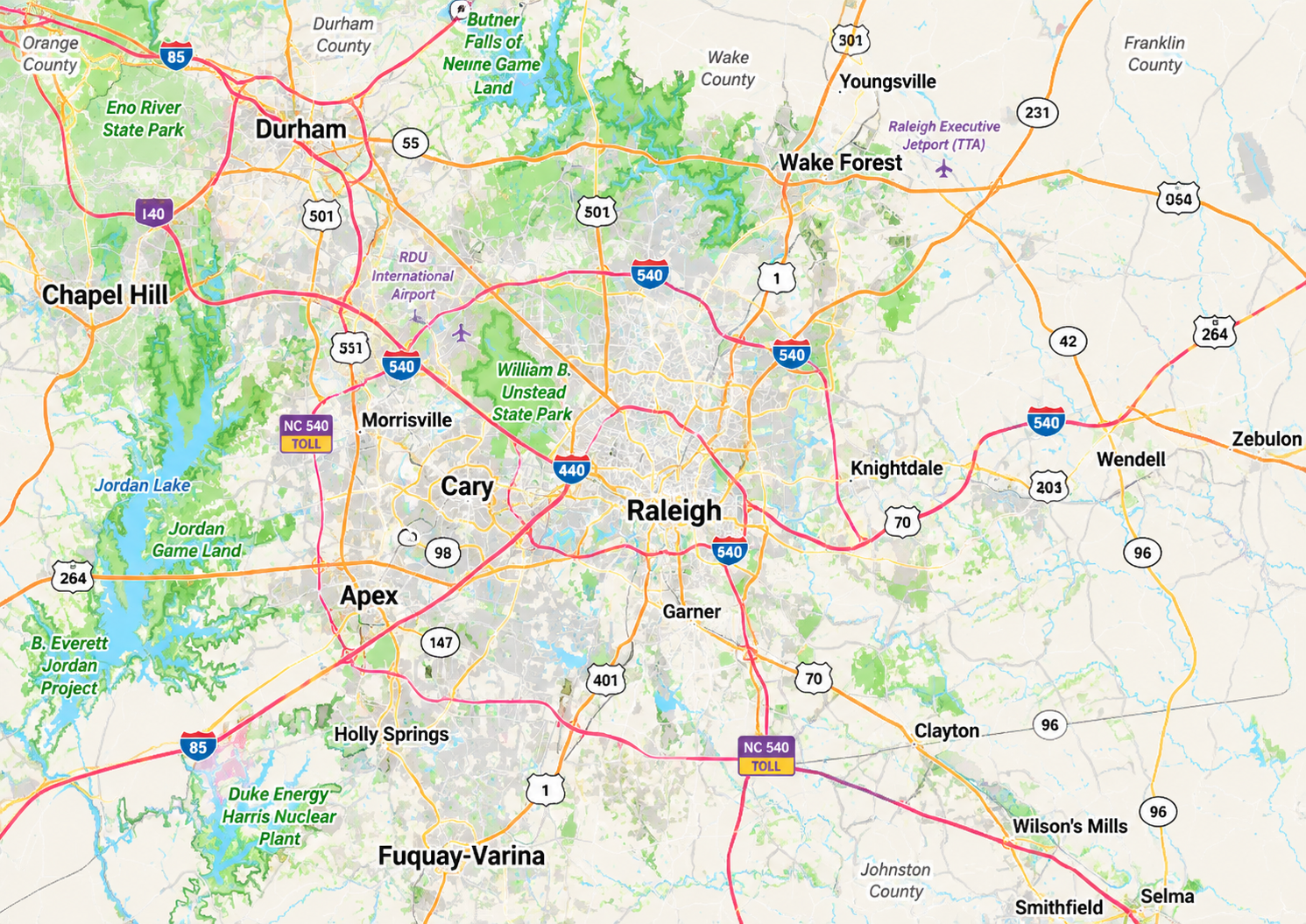
Cary
Typically among the higher-priced markets in the Triangle. Consistently high-performing public schools. Mix of new construction along West Cary / Hwy 55 and established neighborhoods closer to town center. 15–20 min to major employers.
NoVA families who want a well-planned community with strong schools and easy RTP access. May feel structurally familiar to buyers from Reston, Herndon, or Fairfax City.
Higher price point. Some high-demand schools are at capacity.
Cary Relocation Guide →Apex
Generally slightly more affordable than Cary with comparable school quality. Historic downtown. Jordan Lake access. 20–30 min to Raleigh.
Families seeking a small-town feel with genuine character. Often resonates with Ashburn and Loudoun County buyers who want community over density.
Growing traffic on Highway 55. Fewer large employers directly nearby.
Apex Relocation Guide →Morrisville
Closest community to major tech employers — 5–12 min commute to RTP. Generally strong public schools. More apartments and townhomes than single-family stock.
Those who prioritize employer proximity and the shortest possible commute.
Close to West Cary — often considered alongside it.
Best Neighborhoods Near RTP →Holly Springs
Newer homes at a lower price point than Cary. 25–35 min to Raleigh. Strong youth sports infrastructure.
Families looking for the best balance of price and quality of life. Popular with Loudoun County and Hampton Roads buyers.
Longer commute. Retail and dining developing fast.
North Raleigh
Established neighborhoods with mature trees and larger lots. Close to downtown Raleigh.
Buyers who want character, mature landscaping, and resale over new construction. Familiar feel for buyers coming from older Fairfax County or Richmond suburbs.
School quality varies more by neighborhood. Older homes may need updating.
Wake Forest
More space for the money. Family-oriented community with larger lots. 30+ min to downtown Raleigh. Many families consider Wake Forest for its schools, larger homes, and community feel.
Remote workers and buyers from Prince William County or outer Hampton Roads who want maximum space for their budget.
Longest commute to RTP.
Chapel Hill / Carrboro
School district consistently ranks among the top in NC. Walkable town center. University influence. 20–30 min to RTP. Often appeals to buyers who value a college-town atmosphere.
Charlottesville buyers and those who want a university-town feel with strong schools. Good fit for those working at UNC or Duke.
Higher price point. Smaller housing inventory than Cary or Apex.
Fuquay-Varina
Quiet family-oriented town with plenty of new construction. 35–45 min to RTP.
Families looking for newer homes and more space at an accessible price point.
Longer commute to RTP. Area growing quickly — retail and dining catching up.
Garner
Established community south of Raleigh with good highway access (I-40, US-70). More affordable than Cary with a mix of resale and newer construction. 25–35 min to RTP.
Richmond and Hampton Roads buyers looking for a value-oriented Wake County option with a shorter commute than Clayton or Wendell.
Less new construction than Holly Springs or Fuquay-Varina. More suburban and established in character.
Knightdale
Growing community east of Raleigh in Wake County. More affordable than inner-ring suburbs with quick access to downtown Raleigh via US-64.
Buyers who want Wake County schools and Raleigh proximity at a lower price point. Popular with Richmond and Hampton Roads relocants working downtown or east of Raleigh.
Commute to RTP runs 30–40 min. Area developing quickly.
Clayton
Johnston County — the most affordable entry point in the broader Triangle. Newer construction, more land, and prices that reflect the county line. 35–45 min to RTP, 30 min to downtown Raleigh.
Hampton Roads and outer Virginia buyers who want the most home for the budget and are comfortable with a longer commute or work remotely.
Johnston County schools are separate from Wake County — verify schools by address. Longer drive to most Triangle employers.
Wendell
Small town east of Raleigh in Wake County, growing fast with a mix of new construction and older homes on larger lots. One of the more affordable Wake County options.
Buyers who want Wake County and value — particularly remote workers from Hampton Roads or Richmond who don’t need RTP proximity.
Limited local retail and dining for now. Commute to RTP is 35–45 min.
Quick Priority Guide
| Your priority | Consider |
|---|---|
| Best schools | Cary, Chapel Hill, Apex |
| New construction | Apex, Holly Springs, Wake Forest, Fuquay-Varina, Clayton |
| Short RTP commute | Morrisville, Cary |
| Larger lots / mature trees | North Raleigh, Wake Forest |
| Best value in Wake County | Fuquay-Varina, Garner, Knightdale, Wendell |
| Most affordable (Johnston County) | Clayton |
| Walkable downtown feel | Chapel Hill, Carrboro, Downtown Raleigh |
Schools: What Virginia Families Need to Know
Virginia’s school landscape varies significantly by locality. Fairfax County Public Schools and Loudoun County Public Schools are among the strongest large districts in the Mid-Atlantic — comparable in many respects to Montgomery County, Maryland. Richmond City schools are more mixed. Virginia Beach and Chesapeake schools are solid but less uniformly exceptional.
The honest comparison
Families relocating from top-performing Fairfax County or Loudoun County schools should research individual Triangle schools carefully. Wake County and Chapel Hill-Carrboro are strong and compare well against most of the country. Families from Richmond, Hampton Roads, or outer Virginia localities typically find the Triangle schools meet or exceed what they’re leaving.
What NC offers
- Wake County Public Schools: 48 magnet school programs, large system, strong school choice throughout the Triangle. Quality varies by specific school and address.
- Chapel Hill-Carrboro City Schools: Consistently ranks among the top districts in NC. Strong academic reputation with significant university influence.
- School assignment is address-based — always verify the assigned school for any specific address before signing a contract
- Some high-demand schools in Cary are at capacity — ask before you buy or rent
- Charter schools: Free, open enrollment by lottery. Deadlines typically January–February.
Always verify the county and assigned school for your specific address before signing a lease or purchase contract. Use NC School Explorer to check any address.
Raising Kids in North Carolina vs Virginia
- More space — larger yards, newer construction, room to move
- Youth sports infrastructure throughout the Triangle — comparable to NoVA and Richmond suburbs
- 100+ miles of greenway trails in Raleigh alone
- Community pools in most HOA neighborhoods
- Lower cost of activities, camps, and youth programs
- A pace that gives evenings and weekends back
For NoVA families specifically: the structured, activity-dense suburban lifestyle of Fairfax and Loudoun County translates almost directly to Cary and Apex. The infrastructure is there — the commute times are dramatically better.
What a Typical Saturday Looks Like
Saturday in Northern Virginia
Leave by 7am before traffic builds. Drive 35 minutes to a trail that’s already crowded. Sit in 45 minutes of traffic on the way to dinner. Check the time — it’s 9pm. Repeat.
Saturday in Richmond
Drive to Carytown or the Fan. Good brunch, good coffee. The James River is close and it’s nice. Traffic home is manageable. A good day — but it takes effort.
Saturday in the Raleigh area
Walk to the neighborhood greenway. Drive 15 minutes to a farmers market or local brewery. Head to Jordan Lake for the afternoon. Grill in the backyard. Home before dark.
Different pace. Most people who want this Saturday find it within the first month.
Travel and Airport Access
- RDU: Direct flights to most major US cities
- DCA / IAD / BWI: ~4–5 hours by car | or ~1 hour direct flight
- NYC: ~2 hours by air · Chicago: ~2.5 hours · Boston: ~2.5 hours
- Charlotte Douglas (CLT) 2.5 hours away for additional routes
- Direct RDU–DCA and RDU–IAD flights make getting back to Virginia easy for family visits
Weather: Virginia vs North Carolina
For most Virginians, the weather adjustment is minor — the two states share a similar seasonal rhythm. The differences are at the margins, and mostly in NC’s favor.
What Virginians usually like
- Milder winters — the Triangle gets fewer ice and snow events than Northern Virginia or Richmond
- Spring arrives slightly earlier — usually a week or two ahead of the DC corridor
- Summers are comparable — warm and humid, with slightly more heat farther south
- Fall is equally beautiful; the Blue Ridge is 2.5 hours west (similar to Shenandoah from NoVA)
What Virginians sometimes notice
- Summers are slightly longer and warmer than in Northern Virginia
- Pollen season is real — February through May, comparable to Virginia
- Ice events still occur in the Triangle — less frequently than NoVA, but not absent
Hampton Roads exception
Virginia Beach and Norfolk are coastal with genuine hurricane exposure. The Triangle’s inland position (~150 miles from the NC coast) means tropical systems arrive significantly weakened. For Hampton Roads families who have dealt with hurricane preparedness, evacuation decisions, and flood risk, the Triangle’s inland location is often a meaningful factor.
Traffic: Is Raleigh Better Than Virginia?
| Northern Virginia | Richmond | Hampton Roads | Raleigh Area | |
|---|---|---|---|---|
| Average commute | 45–75 min | 30–45 min | 30–50 min | 15–30 min |
| Notorious corridors | I-66, I-95, Dulles Toll Road | I-95, I-64 | Hampton Roads Bridge-Tunnel | US-1, I-40, I-540 |
Northern Virginia traffic is among the worst in the United States — I-66 inside the Beltway during peak hours is a known ordeal. Richmond’s I-95 corridor has worsened significantly as the metro has grown. Hampton Roads has its own specific bottleneck: the Hampton Roads Bridge-Tunnel, which turns minor incidents into major delays.
Triangle traffic is real and growing — but it is not I-66. Former NoVA residents consistently describe the commute change as one of the most immediate and tangible improvements after the move.
Car required in the Triangle — same as most of Virginia outside of Metro-accessible NoVA neighborhoods.
Will I Be Bored?
Virginia has genuine depth — NoVA’s access to Washington, Richmond’s distinct city identity, Hampton Roads’ military and maritime culture, Charlottesville’s academic and wine country character. What you give up depends entirely on where you’re coming from.
If you’re moving from Northern Virginia
The DC gravitational pull diminishes. Museums, Kennedy Center, Georgetown, the specific energy of a world capital — these become planned trips rather than default weekends. The Triangle has a growing cultural scene, but it is not in the orbit of DC. What you gain: your evenings, a backyard, and 45 fewer minutes of commuting per day.
If you’re moving from Richmond
Richmond has developed a genuine city identity over the past decade — a serious food scene, a strong arts district (Scott’s Addition), the James River, and a civic pride that’s distinct from the DC metro area. The Triangle’s food scene (particularly Durham) is comparable in ambition and quality. The James River has no Triangle equivalent — Jordan Lake and Eno River are different but real.
If you’re moving from Hampton Roads / Virginia Beach
Virginia Beach has the Atlantic Ocean, a strong military community, and a coastal lifestyle. The Triangle is inland — Jordan Lake and the NC coast (2.5 hours) partially substitute but don’t replace. What Hampton Roads families gain: no bridge-tunnel commute, no hurricane evacuation planning, and a life sciences and tech job market that doesn’t require military affiliation.
If you’re moving from Charlottesville
Of all Virginia-to-Triangle moves, this one has the most direct equivalent: Chapel Hill. Both are mid-size university towns with walkable downtowns, strong public schools shaped by a flagship university, an educated and professionally dense population, outdoor access in multiple directions, and a food and arts scene that punches above the city’s size. The main differences: Chapel Hill has UNC where Charlottesville has UVA, and the Triangle’s job market is broader than Charlottesville’s. Virginia wine country — the Piedmont and Shenandoah Valley AVAs — has no direct Triangle equivalent.
What’s actually in the Triangle
- Sports: Carolina Hurricanes (NHL), ACC college sports (Duke, UNC, NC State). No NFL in the Triangle — Panthers in Charlotte (2.5 hrs). College basketball is a serious cultural force — comparable in intensity to ACC rivalries Virginians already know.
- Live music: Durham Performing Arts Center (DPAC) — top-grossing mid-size venue nationally.
- Food: James Beard-recognized chefs in Raleigh and Durham. NC BBQ tradition. Growing international scene.
- Outdoors: 100+ miles of greenway trails. Jordan Lake 30 min away. Blue Ridge Parkway 2.5 hours west, Outer Banks 2.5 hours east.
Northern Virginia Tech Professionals
NoVA has become one of the largest tech hubs in the country — Amazon HQ2 in Arlington, Capital One in McLean, Microsoft in Reston, and a dense ecosystem of defense tech contractors throughout Fairfax and Loudoun counties. Many professionals built into this economy are now fully or mostly remote, and the Triangle is a frequent destination.
The RTP ecosystem offers a direct professional bridge: Cisco, Red Hat, IBM have major campuses in RTP; Google, Apple, Epic Games have established Triangle presences; biotech and pharma (Biogen, Bayer, Novo Nordisk) are active in the life sciences corridor; defense tech and cybersecurity companies have a growing footprint, partly driven by the Fort Liberty corridor.
For a NoVA tech professional evaluating the move, the career question is worth thinking through carefully. Silicon Valley-level venture capital and startup density don’t exist here. What does exist: stable, well-paying roles at established tech and life sciences companies, without the NoVA cost of living or the I-66 commute.
Military Families: Virginia to the Triangle
Virginia has one of the highest concentrations of active duty military and veteran communities in the country — the Pentagon, Fort Belvoir, Quantico, Joint Base Langley-Eustis, Naval Station Norfolk, and numerous defense contractors throughout NoVA and Hampton Roads.
The Triangle is a natural next step for many military families completing Virginia assignments. Fort Liberty (formerly Bragg) in Fayetteville is approximately 60 miles south of Raleigh. The Triangle’s defense tech, cybersecurity, and life sciences sectors actively recruit veterans. Duke Health, UNC Health, and the Durham VA Medical Center provide healthcare options.
The honest consideration: If your career requires remaining near a Virginia military installation, the Triangle is not a practical option. For those separating from military service, transitioning to a remote role, or whose spouse’s civilian career can relocate, the Triangle’s quality of life, school options, and cost of living make it a frequently chosen destination.
Virginia vs North Carolina Lifestyle
What’s similar
- Four seasons with a shared Atlantic climate
- Strong faith communities and outdoor culture
- Pride in local food and local identity
- ACC sports rivalries — Virginia fans find the Triangle’s college basketball culture immediately familiar
What’s different
- NoVA’s proximity to federal power and national events has no equivalent in the Triangle
- The Triangle has a stronger university-employer culture — NC State, Duke, and UNC shape the professional community differently from the government-contractor economy of NoVA
- The pace is genuinely slower than NoVA. Richmond is already somewhat slower; Hampton Roads slower still. The Triangle fits somewhere in that range
The Triangle specifically: RTP anchors major employers including Apple, Google, Cisco, Red Hat, and Biogen. The workforce draws from across the country through its employer base, producing a range of dining options, cultural institutions, and professional networks that Virginians from major metro areas tend to find familiar.
Remote Workers: Which Triangle Area Works Best?
NoVA’s economy has a large population of hybrid and remote workers — federal contractors, tech professionals, and consultants whose DC access became optional in 2020. For those who are now fully remote, the Triangle is a frequent landing point.
- Wake Forest — more space, lower prices, quieter pace
- Holly Springs — newer construction, strong community feel
- Fuquay-Varina — most affordable, fastest growing
- North Raleigh — established neighborhoods, larger lots, easy highway access
All major Triangle communities have access to high-speed internet including fiber options. Remote Workers in the Triangle — Full Guide →
How Buying a Home in NC Differs From Virginia
- Due Diligence Fee: Non-refundable fee paid directly to the seller at contract. Virginia uses a different earnest money structure — this is the most important difference to understand before making an offer.
- Attorney state: NC requires a real estate attorney at closing. Virginia also uses attorneys in many transactions, so this will feel familiar.
- Speed: 30-day closes are standard.
- HOA communities: Common in NC new construction — familiar to NoVA buyers who have lived in Reston, Ashburn, or similar planned communities.
- Vehicle personal property tax: Virginia’s annual vehicle tax ends when you establish NC residency. NC charges an annual vehicle property tax via the DMV plus a flat registration fee — still typically much lower than what Virginia households pay on newer vehicles.
Common Mistakes Virginia Buyers Make When Relocating
- Assuming NoVA school quality is universal in the Triangle. Fairfax County schools are genuinely strong. Wake County varies meaningfully by address. Research before you commit.
- Not accounting for the distance from DC. 4–5 hours is a planned trip. If quarterly family visits to Northern Virginia are part of the plan, build that in.
- Underestimating lot size differences. NoVA townhome buyers sometimes expect similar density in the Triangle. New construction neighborhoods here often have more land — but not always. Tell your agent upfront what matters.
- Skipping the Due Diligence process. NC home buying works differently from Virginia. The non-refundable Due Diligence Fee is real money at risk from day one.
- Not verifying school assignment by address. A house one street over can mean a different school. Always confirm the specific address before signing.
- Visiting only in spring. Spring in NC is beautiful. Come back in July to experience the humidity before you commit.
What Former Virginians Love — and Miss
What they love
- “The commute. I got my evenings back. That’s the whole story.”
- “My car registration bill disappeared. I didn’t realize how much Virginia’s personal property tax was until it was gone.”
- “The schools are better than I expected. We did the research and found a great fit for our kids.”
- “Same four seasons. Slightly warmer winters. I’ll take it.”
- “Apex feels like Ashburn used to feel before Ashburn got expensive.”
- “Durham’s food scene is serious. I was not prepared for that.”
- “We go to the mountains on weekends now. It’s two and a half hours — same as Shenandoah was from Reston.”
What Virginians miss
- Northern Virginia’s DC access. The Kennedy Center, the Smithsonian, Georgetown — proximity to Washington is a real thing to give up. It becomes a planned trip instead of a default weekend.
- The James River (for Richmond people). Jordan Lake is nice. It’s not the James.
- Virginia wine country. The Charlottesville and Piedmont wine regions have developed into something genuinely special. NC has a growing wine scene but it’s not the same footprint or reputation.
- Shenandoah proximity (for NoVA residents). Skyline Drive is about 75–90 minutes from Northern Virginia. The Blue Ridge Parkway is 2.5 hours from the Triangle — still accessible, but no longer an easy afternoon.
- Hampton Roads ocean access. Virginia Beach has direct Atlantic access. NC’s Outer Banks (2.5 hours) are beautiful but not as convenient.
- Virginia sports rivalries. Hokies vs Cavaliers is real and specific. ACC rivalries in NC are equally intense — but Virginia fans find their specific allegiances don’t transfer.
- Family and community roots. Virginia families are often multigenerational in their communities. That’s real.
Is Moving from Virginia to Raleigh Right for You?
You may love it here if
- You’re in Northern Virginia and the traffic and housing costs are driving the decision
- You work remotely and no longer need physical proximity to a Virginia employer or federal facility
- You want more house, more land, and lower ongoing costs
- You want a comparable four-season climate with milder winters
- You want a professional community with real career options that isn’t tethered to government contracting
Usually a good fit
- NoVA families priced out of Fairfax or Loudoun County
- Military families completing Virginia assignments and choosing civilian life in the Southeast
- Remote workers in tech, defense tech, or life sciences who no longer need a Virginia commute
- Buyers from Richmond or Hampton Roads looking for lower ongoing costs and a growing job market
You may miss Virginia if
- You work at or near a Virginia military installation or federal facility that requires physical presence
- DC cultural access — museums, Kennedy Center, Georgetown — is central to your weekend life
- Your children are in top-performing Fairfax County schools and school quality is the primary criterion
- Your family and social roots are deep in Virginia
May not be a good fit
- Active duty or contractors requiring physical presence at Virginia military or federal facilities
- Families at top-performing Fairfax County schools for whom that specific quality level is non-negotiable
- Those who genuinely need regular DC or Northern Virginia access for work or family
Frequently Asked Questions

Moving from Virginia to the Triangle?
I’ve helped Virginia families compare Cary, Apex, Holly Springs, Morrisville, and Wake Forest — and navigate NC tax savings, school assignments, builder contracts, and due diligence along the way.