
Moving from Maryland to North Carolina
Is It Worth It?
Compare housing, taxes, schools, traffic, weather, and daily life — including the honest tradeoffs — before you make the move.
Free 30-minute consultation · English & Russian
Anna Rukhlina · Real Estate Broker · DASH Carolina
Why Marylanders Are Moving to North Carolina
Maryland is a strong state — excellent schools, solid economy, close to Washington, D.C. Most people who leave aren’t escaping a broken situation. They’re making a deliberate trade.
Maryland is also one of the more underrated sources of Triangle relocants. The move doesn’t make headlines the way California does — but the profile fits well, and former Marylanders tend to adjust quickly.
Taxes: The Picture Is Different Here
Unlike the Texas and Florida pages, this section has good news.
Maryland has a state income tax that ranges from 2% to 5.75% — plus a county income tax on top of that. County rates vary but typically run between 2.25% and 3.2% depending on where you live. Montgomery County, Howard County, and Baltimore County all carry county rates in that range. The combined Maryland state and local income tax burden for a mid-to-high earner can reach 7–9%.
North Carolina has a flat 3.99% state income tax (2026) with no county income tax. For most Maryland earners, moving to NC means paying less in income tax — sometimes significantly less.
Property taxes tell a similar story. Maryland county rates vary, but Montgomery County and Howard County both run around 1.0–1.1% effective rates. Wake County combined rates are ~0.84–0.87% — on homes that often cost less than comparable Maryland properties.
Vehicle registration: Maryland vehicle-related costs — including titling excise and registration — typically run higher than NC’s annual vehicle property tax via the DMV plus flat registration fee, particularly for newer vehicles.
The net picture
For most Maryland households: both income and property taxes are likely to go down. This is different from what Texans or Floridians face, and it changes the financial calculation meaningfully.
NC income tax is scheduled to decrease: 3.49% by 2027, 3.14% by 2030. Tax laws change and individual situations vary. Consult a licensed CPA for your specific situation.
Maryland vs Raleigh Area: At a Glance
| Category | Maryland (DC suburbs) | Raleigh Area |
|---|---|---|
| Home prices | High — Montgomery/Howard among most expensive in the East | Significantly lower in most comparisons |
| State income tax | 2–5.75% + county income tax (2.25–3.2%) | 3.99% flat — no county income tax |
| Property tax (effective rate) | ~1.0–1.1% (Montgomery, Howard) | ~0.84–0.87% (Wake Co. + city)* |
| Sales tax | 6% | 7.3% (Wake County) |
| Gas | Above national average | Below national average |
| Childcare (full-time) | Among the most expensive in the region | Significantly lower |
| Average commute | 40–75 min (DC suburbs) | 15–30 min |
* Combined Wake County + city rate. Varies by municipality. Check wake.gov.
What Your Maryland Budget Buys in the Triangle
The comparison is favorable for most Maryland buyers — but it depends on your county and price point.
Coming from Montgomery County or Howard County
These are among the most expensive housing markets in the Mid-Atlantic. The Triangle typically offers more square footage, newer construction, and larger lots for a comparable or lower price.
Coming from Baltimore County or Anne Arundel County
These markets are somewhat more affordable than Montgomery County, and Triangle pricing is broadly comparable — with the advantage shifting to ongoing costs: lower taxes and, in most cases, lower insurance.
Coming from Prince George’s County
Pricing is more comparable to Triangle markets. The financial case here centers more on income tax savings, commute improvement, and cost of living broadly.
| Budget level | What it typically buys |
|---|---|
| Mid-range Montgomery County budget | Often buys a larger, newer home in a top Triangle community |
| Mid-range Howard / Anne Arundel budget | Broadly comparable; lower taxes and ongoing costs |
| Higher-end Maryland budget | Access to custom homes, larger lots, established neighborhoods |
Why Many Maryland Buyers Choose New Construction
The Triangle has an unusually high volume of new construction compared to the DC-area market, where resale inventory dominates and bidding wars are common. For many Maryland buyers, this is a welcome shift.
- More inventory available than in a typical resale market
- Builder incentives — rate buydowns, closing cost assistance
- Modern open floor plans and finishes
- Energy efficiency and builder warranties (typically 1-2-10 year)
- Lower maintenance in early years
- Community amenities — pools, trails, playgrounds — built in
Where Maryland Residents Usually Choose to Live
If you know where you’re coming from, this helps narrow it down:
| Coming from | Often consider |
|---|---|
| Montgomery County / Bethesda / Rockville | Cary, Morrisville, Apex |
| Howard County / Columbia | Cary, Apex, Chapel Hill |
| Baltimore County / Towson | North Raleigh, Apex, Wake Forest |
| Anne Arundel / Annapolis | Apex, Holly Springs, Wake Forest |
| Prince George’s County | Holly Springs, Fuquay-Varina, Wake Forest |
These aren’t exact equivalents — but buyers from each area tend to respond to similar things in the Triangle:
| Maryland area | Often appeals to buyers from |
|---|---|
| Cary | Bethesda, Rockville, Columbia |
| Cary / Morrisville | Gaithersburg, Germantown |
| Apex | Columbia, Ellicott City, Annapolis |
| North Raleigh | Towson, Timonium |
| Chapel Hill | Annapolis, parts of Howard County |
| Wake Forest | Anne Arundel County, outer Baltimore suburbs |
Cary
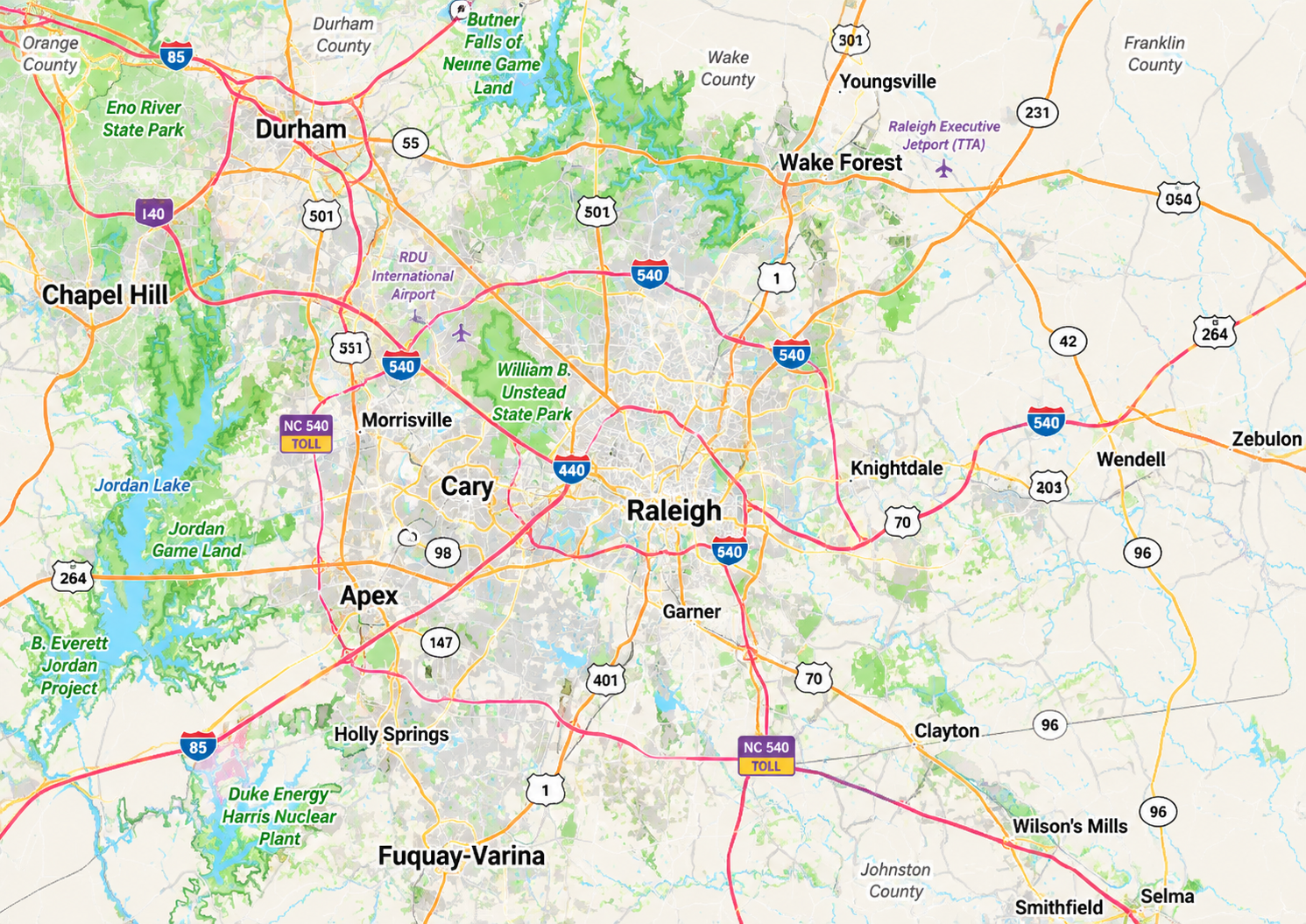
Typically among the higher-priced markets in the Triangle. Consistently high-performing public schools. Mix of new construction along West Cary / Hwy 55 and established neighborhoods closer to town center. 15–20 min to major employers.
Montgomery County and Howard County families who want a well-planned community with strong schools and easy access to RTP. May feel structurally familiar to buyers coming from Gaithersburg, Rockville, or Columbia.
Higher price point. Some high-demand schools are at capacity.
Cary Relocation Guide →Apex
Generally slightly more affordable than Cary with comparable school quality. Historic downtown. Jordan Lake access. 20–30 min to Raleigh.
Families seeking a small-town feel with genuine character and a strong sense of community.
Growing traffic on Highway 55. Fewer large employers directly nearby.
Apex Relocation Guide →Morrisville
Closest community to major tech employers — 5–12 min commute to RTP. Generally strong public schools. More apartments and townhomes than single-family stock.
Those who prioritize employer proximity and a shorter commute.
Close to West Cary — often considered alongside it.
Best Neighborhoods Near RTP →Holly Springs
Newer homes at a lower price point than Cary. 25–35 min to Raleigh. Strong youth sports infrastructure.
Families looking for the best balance of price and quality of life.
Longer commute. Retail and dining developing fast.
North Raleigh
Established neighborhoods with mature trees and larger lots. Close to downtown Raleigh.
Buyers who want character, mature landscaping, and resale over new construction. Familiar feel for buyers coming from older Maryland suburbs.
School quality varies more by neighborhood. Older homes may need updating.
Wake Forest
More space for the money. Family-oriented community with larger lots. Growing fast. 30+ min to downtown Raleigh. Many families consider Wake Forest for its schools, larger homes, and community feel.
Remote workers or buyers not tied to RTP. Those who want maximum space for their budget.
Longest commute to RTP.
Chapel Hill / Carrboro
School district consistently ranks among the top in NC. Walkable town center. University influence. 20–30 min to RTP. Often appeals to buyers who value a college-town atmosphere.
Families who prioritize schools above all else. Those who want a walkable downtown with an academic character. Strong draw for buyers with ties to UNC or Duke.
Higher price point. Smaller housing inventory than Cary or Apex.
Fuquay-Varina
Most affordable. Quiet family-oriented town with plenty of new construction. 35–45 min to RTP.
Those looking for newer homes, more space, and accessible price.
Longest commutes. Area growing quickly.
Quick Priority Guide
| Your priority | Consider |
|---|---|
| Best schools | Cary, Chapel Hill, Apex |
| New construction | Apex, Holly Springs, Wake Forest, Fuquay-Varina → New Construction in Triangle NC |
| Short RTP commute | Morrisville, Cary |
| Larger lots / mature trees | North Raleigh, Wake Forest |
| Best value | Fuquay-Varina, Wake Forest |
| Walkable downtown feel | Chapel Hill, Carrboro, Downtown Raleigh |
Schools: What Maryland Families Need to Know
The honest comparison
Wake County and Chapel Hill-Carrboro are strong. They compare well against most of the country. They are not Montgomery County — one of the most well-funded and consistently high-performing large districts in the United States. Families who make school district quality their primary criterion should research carefully before deciding.
What NC does offer
- Wake County Public Schools: One of the largest districts in NC with 48 magnet school programs, strong school choice options, and generally well-regarded schools throughout the Triangle. Quality varies by specific school and address.
- Chapel Hill-Carrboro City Schools: Consistently ranks among the top districts in NC. Strong academic reputation and university influence.
- School assignment is address-based — always verify the assigned school for any specific address before signing a contract
- Some high-demand schools in Cary are at capacity — ask before you buy or rent
- Charter schools: Free, open enrollment by lottery. A meaningful alternative for many families. Deadlines typically January–February.
- Private school options: A growing range throughout the Triangle, including options affiliated with Duke and UNC
The bottom line: If your family is currently at one of Montgomery County’s highest-rated schools, do the research. If you’re in a mid-tier Maryland district, the Triangle holds up well in comparison.
Always verify the county and assigned school for your specific address before signing a lease or purchase contract. Use NC School Explorer to check any address.
Raising Kids in North Carolina vs Maryland
- More space — yards, backyards, room to move
- Youth sports infrastructure throughout the Triangle — comparable to Howard and Montgomery County
- 100+ miles of greenway trails in Raleigh alone
- Community pools in most HOA neighborhoods
- Lower cost of activities, camps, and lessons
- A pace that makes evenings and weekends feel less compressed
What Maryland families often say after moving: the school quality was closer than expected, and the space and pace were the bigger changes. Kids who spent weekends in structured activities in Maryland often end up with more unstructured outdoor time in the Triangle — and parents report that as a net positive.
What a Typical Saturday Looks Like
Saturday in Montgomery County
Drive 20 minutes to Bethesda. Pay $18 for parking. Drive 35 minutes to a trail. Sit on the Beltway for 40 minutes on the way home. Realize you forgot something on the list and don’t go back.
Saturday in Baltimore suburbs
Drive to the Inner Harbor. Find parking. Good crabs, traffic home. Tired by 4pm.
Saturday in the Raleigh area
Walk to the neighborhood trail or pool. Drive 15 minutes to a farmers market. Head to Jordan Lake for the afternoon. Grill in the backyard. Leaves are turning in October. Home before dark.
Different pace. Most people who want this Saturday find it within the first month.
Travel and Airport Access
- RDU: Direct flights to most major US cities
- BWI / DCA / Dulles: ~4–4.5 hours by car | or direct flight ~1 hour
- NYC: ~2 hours by air · Chicago: ~2.5 hours · Boston: ~2.5 hours
- Charlotte Douglas (CLT) 2.5 hours away for additional routes
- Easy to get back to Maryland for family visits — direct RDU–BWI flights are short and frequent
Weather: Maryland vs North Carolina
For Marylanders, this is not a dramatic change — it’s a moderate upgrade in most seasons.
Maryland already has four seasons. NC’s are similar, but shifted slightly warmer. Winters in the Triangle are milder than in the DC-Baltimore corridor — less ice, less cold. Summers are warm and humid — comparable to Maryland, though slightly warmer.
What Marylanders usually like
- Milder winters — fewer ice events than Maryland, less brutal cold snaps
- Spring arrives earlier — consistently a week or two ahead of the DC area
- Fall is equally beautiful, possibly more so in the mountains 2.5 hours west
- Blue Ridge Mountains 2.5 hours away, Outer Banks 2.5 hours east
What Marylanders sometimes notice
- Summers are slightly hotter and longer than in Maryland
- Pollen season is real — February through May, comparable to or slightly more than Maryland
- Ice storms can still affect the Triangle a few times per year
What NC doesn’t have
- The frequency and severity of DC-area ice and snow events that shut down the region
- Maryland’s humidity is comparable — NC is not drier in summer
Traffic: Is Raleigh Better Than the DC Corridor?
| DC Suburbs (MD) | Baltimore | Raleigh Area | |
|---|---|---|---|
| Average commute | 45–75 min | 35–55 min | 15–30 min |
| Rush hour | 5:30am–10am, 2pm–8pm | Extended peak periods | 7am–9am, 4pm–6pm |
DC-area traffic is among the worst in the United States — I-270, I-495, and I-95 are consistently ranked in national congestion studies. Baltimore traffic is serious, particularly on the beltway and I-83.
Triangle traffic is growing but remains in a different category. Former Marylanders consistently cite the commute improvement as one of the most immediate and noticeable quality-of-life changes after the move.
Car required in the Triangle — same as Maryland outside of DC Metro access zones.
Will I Be Bored?
Maryland residents — particularly DC-area residents — have access to some of the best free cultural resources in the world. The Smithsonian, Kennedy Center, National Gallery, and the density of international dining and neighborhoods in DC are genuinely hard to replicate.
If you’re moving from the DC suburbs (Montgomery, Howard County)
You are giving up proximity to Washington. That is real. Weekend trips to DC become occasional trips rather than easy drives. The Triangle has its own cultural scene — but it is not the Kennedy Center, it is not Georgetown, and the international dining diversity of the DC area is something the Triangle is still building toward.
If you’re moving from Baltimore
Baltimore has a distinct identity — the Inner Harbor, a serious food scene (particularly seafood), strong arts institutions, and a proud local character. The Triangle’s arts scene is comparable in some ways (Durham Performing Arts Center is nationally significant) but smaller in scale. The seafood culture is one of the hardest things for Baltimore transplants to replace.
What’s actually here
- Sports: Carolina Hurricanes (NHL), ACC college sports (Duke, UNC, NC State). No NFL in the Triangle — Panthers are in Charlotte (2.5 hrs). No NBA. College basketball is a serious cultural force in a way that’s similar to the ACC’s role in Maryland.
- Live music: Durham Performing Arts Center (DPAC) — top-grossing mid-size venue nationally. Growing local scene in Durham and Raleigh.
- Food: James Beard-recognized chefs in Raleigh and Durham. Growing international dining scene. NC BBQ culture with a distinct regional tradition.
- Museums: NC Museum of Art — free admission. Strong university museum collections at Duke and UNC.
- Outdoors: 100+ miles of greenway trails. Jordan Lake 30 minutes away. Mountains 2.5 hours west, beaches 2.5 hours east.
- DC day trips: About 4–4.5 hours. Doable for a long weekend. Not a quick drive.
Old Bay, Blue Crabs, and the Chesapeake: An Honest Section
This will come up. Maryland’s food identity is specific and genuine.
Blue crabs, steamed with Old Bay, eaten at a paper-covered table — that is a Maryland cultural institution. The Chesapeake Bay seafood tradition (crab cakes, rockfish, oysters) is tied to a specific geography that North Carolina doesn’t have in the same form.
NC has its own seafood culture — the coast is excellent for fresh fish, shrimp, and oysters, and the Outer Banks and Crystal Coast are genuine destinations. It’s not the Chesapeake. It’s its own thing. Old Bay is available in NC grocery stores. That part is fine.
Maryland vs North Carolina Lifestyle
Maryland is Mid-Atlantic — neither full South nor full Northeast. NC, and the Triangle specifically, is also its own hybrid: Southern in character outside the Triangle, more mixed and professional within it.
What’s similar
- Four seasons and the rhythms that come with them
- Strong faith communities
- Pride in local sports and local identity
- Suburban family culture with HOA communities, youth sports, and planned neighborhoods
What’s different
- The DC gravitational pull is gone. For some people, that’s a relief. For others, it’s disorienting at first.
- The Triangle has a stronger university culture than most Maryland suburbs — NC State, Duke, and UNC shape the character of the area in ways that feel different from the government-contractor culture of the DC corridor.
- The pace is genuinely slower. Less ambient urgency. Most people who wanted this find it quickly.
The Triangle specifically: RTP anchors major employers including Apple, Google, Cisco, Red Hat, and Biogen. The workforce is large, professional, and draws from across the country. The resulting community has a range of restaurants, cultural institutions, and professional networks that Marylanders from major counties tend to find familiar.
Moving from Annapolis or Anne Arundel County
Annapolis and Anne Arundel County have a distinct character — water-oriented, historically grounded, less DC-corporate than Montgomery or Howard County. The profile of someone leaving Annapolis is different from someone leaving Bethesda or Columbia.
What Annapolis-area buyers tend to look for in the Triangle:
- Water and outdoor access — Jordan Lake, the Eno River, Falls Lake, and weekend access to the Outer Banks and NC coast partially fill the gap
- Strong schools in a less urban setting — Wake County and Chapel Hill-Carrboro hold up well in comparison
- Family neighborhoods with a community feel — Apex and Chapel Hill most often come up
- Less traffic — Anne Arundel sits between DC and Baltimore, with commutes into both
Communities that tend to resonate: Apex for its historic downtown and community feel, Chapel Hill for a similar small-city-with-water-nearby character, Wake Forest for buyers who want more land and a quieter pace.
Federal Employment: The Honest Consideration
Maryland has the highest concentration of federal government employees and contractors in the country outside of the DC core. NIH, FDA, NSA, USDA, NASA Goddard, and dozens of defense and intelligence contractors are embedded in the Maryland economy.
If your job requires physical presence at a Maryland or DC federal facility, the Triangle is not a realistic remote option. This is the clearest reason not to make this move, and it’s worth saying directly.
If you work for a federal agency or contractor and are fully remote — or if your role can be transferred to RTP-area employers — the financial and lifestyle case for the move is strong. The Triangle has a growing presence in life sciences, cybersecurity, and defense tech.
Life sciences professionals from the NIH, FDA, and the I-270 biotech corridor often find a familiar professional ecosystem in the Triangle. Research Triangle Park has a significant life sciences concentration — Biogen, Bayer, Novo Nordisk, and dozens of smaller biotech and pharma companies are based here, alongside clinical research organizations tied to Duke and UNC Health.
If you’re approaching retirement from a federal career and looking at where to land next, the Triangle has become a common destination. Strong healthcare systems (Duke Health, UNC Health, WakeMed), lower taxes, and manageable cost of living make it a practical choice.
Remote Workers: Which Triangle Area Works Best?
Maryland’s federal and contractor economy has produced a large population of professionals who discovered during 2020–2022 that their work could be done remotely. For those who are now fully or mostly remote, the Triangle is a natural landing point.
If you work remotely, you don’t need to be near RTP. That opens up areas commuters often overlook:
- Wake Forest — more space, lower prices, quieter pace
- Holly Springs — newer construction, strong community feel
- Fuquay-Varina — most affordable, fastest growing, room to breathe
- North Raleigh — established neighborhoods, larger lots, easy highway access
All major Triangle communities have access to high-speed internet including fiber. This is rarely a limiting factor in your neighborhood choice. Remote Workers in the Triangle — Full Guide →
How Buying a Home in NC Differs From Maryland
- Due Diligence Fee: Non-refundable fee paid to the seller at contract. Maryland uses a different earnest money structure — money is at risk from day one in NC.
- Attorney state: NC requires a real estate attorney at closing. Maryland also uses attorneys, so this will feel familiar.
- Speed: 30-day closes are standard in NC. Maryland contracts can move at a similar pace in competitive markets.
- HOA communities: Common in NC new construction — familiar to most Maryland suburban buyers.
- Home construction: NC homes often have crawl spaces rather than the full basements common in Maryland. Fiber cement siding (HardiePlank) is the standard exterior finish in NC new construction. If you’re buying resale, a good NC inspector will walk you through the differences.
Common Mistakes Maryland Buyers Make When Relocating
- Assuming school quality is uniform. Maryland buyers sometimes expect every Triangle school to match Montgomery County’s top performers. School quality varies meaningfully by neighborhood and address. Research before you commit.
- Underestimating the distance from DC. 4–4.5 hours is a day trip, not a quick drive. If quarterly visits to family in Maryland are part of the plan, build that into your thinking.
- Not visiting multiple areas. Cary and Durham are 20 minutes apart and feel like different worlds. Raleigh and Wake Forest are both “Raleigh area” but the feel is completely different.
- Focusing only on sticker price. The financial case is real — but run the full numbers: HOA fees, property tax on the new purchase price, NC income tax, and insurance.
- Skipping the Due Diligence process. NC home buying works differently from Maryland. Understand it before you make an offer.
- Not researching school assignments before signing. Assignment is address-based. A house one street over can be a different school. Verify the specific address.
What Former Marylanders Love — and Miss
What they love
- “The commute. I gave back 90 minutes of my day. Every day.”
- “My tax bill. Both income and property. I ran the numbers three times because I didn’t believe it.”
- “The pace. I didn’t realize how compressed everything felt until it stopped.”
- “Fall here is just as good as Maryland. I was worried about that.”
- “The school situation is better than I expected. We did the research and found a great fit.”
- “The mountains are two and a half hours. We actually use them.”
- “Durham’s food scene is serious. It surprised me.”
What they miss
- Washington, D.C. The Smithsonian, Kennedy Center, the Mall, Georgetown — proximity to one of the world’s great capitals is a real thing to give up. It becomes a planned trip instead of a default weekend option.
- Blue crabs and the Chesapeake. Maryland’s crab culture is specific and genuine. NC’s coast is good — it’s not the same.
- Montgomery and Howard County schools. For families in the top tier of those districts, this is a real trade. NC’s schools are good. They are not Montgomery County Public Schools at its best.
- East Coast train access. Amtrak from BWI or Union Station gives Maryland residents easy access to Philadelphia, New York, and Boston. From Raleigh, Amtrak exists but is slower and less practical. You fly.
- The sense of being at the center of things. The DC area hums with national significance. Raleigh doesn’t carry that weight — for most people, that’s a feature, not a bug. But some miss it.
- Family and community roots. Maryland families are often multigenerational in the DC-Baltimore corridor. That’s real.
Is Moving from Maryland to Raleigh Right for You?
You may love it here if
- Your combined Maryland income tax burden is higher than NC’s 3.99% flat rate
- DC-area traffic is affecting your quality of life
- You want more house, more land, and lower ongoing costs
- You work remotely and no longer need to be near a Maryland employer
- You want a slower pace without giving up four seasons or East Coast access
Usually a good fit
- Families from Howard County, Anne Arundel, or Baltimore County who want more space and lower taxes
- Remote workers from the federal contracting world who no longer need physical DC proximity
- Buyers who want strong schools but are currently in a mid-tier Maryland district
- Those approaching a career transition and looking at long-term cost of living
You may miss Maryland if
- You work at or near a federal facility that requires physical presence
- DC cultural access — museums, concerts, neighborhoods — is central to your weekend life
- Your children are in a top-performing Montgomery County or Howard County school and school quality is your primary criterion
- Your family and social roots are deep in the DC-Baltimore corridor
May not be a good fit
- Federal employees or contractors whose work requires being near DC or a Maryland facility
- Families currently at top-tier Montgomery County schools where school quality is non-negotiable
- Those who genuinely need regular DC access for work, culture, or family
Frequently Asked Questions

Moving from Maryland to the Triangle?
I’ve helped Maryland families compare Cary, Apex, Holly Springs, Morrisville, and Wake Forest — and navigate NC tax savings, school assignments, builder contracts, and due diligence along the way.