Moving from Massachusetts to North Carolina
Is It Worth It?
Compare housing, taxes, schools, traffic, weather, and daily life — including the honest tradeoffs — before you make the move.
Free 30-minute consultation · English & Russian
Anna Rukhlina · Real Estate Broker · DASH Carolina
Why Massachusetts Residents Are Moving to North Carolina
Massachusetts consistently ranks among the top states for education, healthcare, and quality of life. Most people who leave aren’t fleeing failure — they’re trading a place that has a lot going for it for a place that’s easier to live in day to day.
The reasons come up consistently:
Massachusetts is one of the more underrated sources of Triangle relocants. The move makes intuitive sense — educated workforce, family-focused, university-town sensibility — and former Massachusetts residents tend to feel at home in the Triangle faster than they expect.
Taxes: The Picture Is Favorable
Massachusetts has a flat 5% state income tax — plus a 4% surtax on income over $1 million (passed in 2022). North Carolina has a flat 3.99% rate (2026). For most Massachusetts earners, moving to NC means paying less in income tax. This is a real and consistent benefit of the move.
Property taxes tell a more nuanced story. Massachusetts effective rates typically run 1.0–1.2% depending on the town — but on homes that are dramatically more expensive than Triangle equivalents. The rate difference is moderate; the dollar difference is often significant. A $700,000 home in Newton at 1.1% generates more than twice the annual tax bill of a $400,000 home in Cary at 0.85%.
Vehicle excise tax: Massachusetts charges an annual excise tax of $25 per $1,000 of vehicle value. NC charges an annual vehicle property tax (collected through the DMV at registration) plus a flat registration fee — together typically 3–4x lower than Massachusetts for most households.
NC income tax is scheduled to decrease: 3.49% by 2027, 3.14% by 2030. Consult a licensed CPA for your specific situation.
Massachusetts vs Raleigh Area: At a Glance
| Category | Massachusetts | Raleigh Area |
|---|---|---|
| Home prices | Among the highest in the country — Greater Boston especially | Significantly lower in most comparisons |
| State income tax | 5% flat (+ 4% surtax over $1M) | 3.99% flat* |
| Property tax (effective rate) | ~1.0–1.2% on expensive homes | ~0.84–0.87% (Wake Co. + city)** |
| Vehicle excise tax | Annual — $25 per $1,000 of value | Annual property tax via DMV + flat registration fee — typically 3–4x lower than MA |
| Sales tax | 6.25% | 7.3% (Wake County) |
| Gas | Above national average | Below national average |
| Childcare (full-time) | Among the most expensive in the country | Significantly lower |
| Average commute | 35–70 min (Greater Boston) | 15–30 min |
| Winters | Real — snow, ice, cold from November through March | Mild — a few events per year, rarely sustained |
* NC income tax scheduled to decrease: 3.49% by 2027, 3.14% by 2030.
** Combined Wake County + city rate. Varies by municipality. Check wake.gov.
What Your Massachusetts Budget Buys in the Triangle
Coming from Greater Boston (Newton, Lexington, Concord, Wellesley, Brookline)
These are among the most expensive housing markets in the country. A Triangle budget that would buy a modest cape in a good Boston suburb typically buys a significantly larger, newer home in a top Triangle community — often with more land, a newer build, and lower property taxes.
Coming from MetroWest or the North/South Shore
More moderate than inner suburbs but still substantially above Triangle pricing. The shift is meaningful and immediate.
Coming from Worcester
Worcester is more affordable than Boston. Triangle pricing is broadly comparable in many neighborhoods — the financial case here centers more on winter escape, income tax savings, and cost of living broadly.
Coming from Western Massachusetts (Springfield, Northampton area)
Pricing is comparable to Triangle markets in many cases. The draw is often quality of life, winter climate, and job market rather than a dramatic housing cost gap.
| Budget level | What it typically buys |
|---|---|
| Mid-range Greater Boston budget | Often buys a significantly larger, newer home in a top Triangle community |
| Mid-range MetroWest / Shore budget | Larger home; lower taxes and ongoing costs |
| Higher-end Massachusetts budget | Access to custom homes, larger lots, established neighborhoods |
Where Massachusetts Residents Usually Choose to Live
If you know where you’re coming from, this helps narrow it down:
| Coming from | Often consider |
|---|---|
| Greater Boston / Inner suburbs (Newton, Lexington, Brookline) | Cary, Apex, Chapel Hill |
| MetroWest (Framingham, Natick, Hopkinton) | Cary, Apex, Holly Springs |
| North Shore (Salem, Beverly, Newburyport) | Apex, Wake Forest, North Raleigh |
| South Shore (Quincy, Hingham, Duxbury) | Holly Springs, Apex, Wake Forest |
| Worcester area | Wake Forest, Holly Springs, Fuquay-Varina |
| Cape Cod / retirement-oriented | Wake Forest, North Raleigh, Chapel Hill |
| Pioneer Valley (Northampton, Amherst, Hadley) | Chapel Hill, Carrboro, Durham |
Massachusetts areas and their Triangle counterparts — not exact equivalents, but communities that tend to resonate:
| Massachusetts area | Often appeals to buyers from |
|---|---|
| Cary | Newton, Lexington, Natick, Framingham |
| Apex | Concord, Acton, Hopkinton, Hingham |
| Chapel Hill | Northampton, Amherst, Cambridge, Somerville |
| North Raleigh | Beverly, Danvers, outer Middlesex County |
| Wake Forest | Worcester suburbs, South Shore outer towns |
| Holly Springs | Milford, Bellingham, outer MetroWest |
| Garner / Knightdale | Buyers prioritizing value in Wake County |
| Clayton | Most affordable entry point; Johnston County schools — verify separately |
Cary
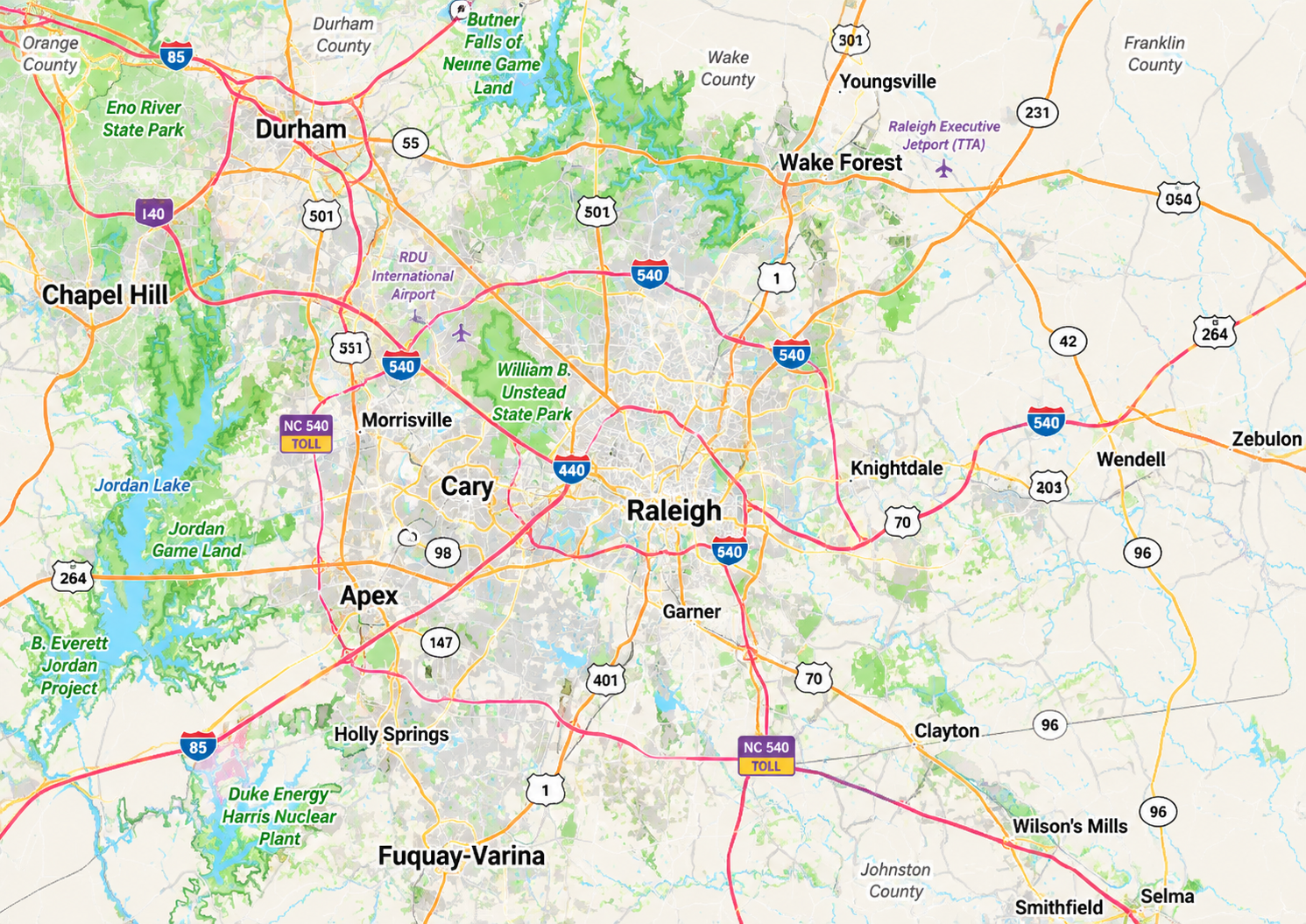
Typically among the higher-priced markets in the Triangle. Consistently high-performing public schools. Mix of new construction and established neighborhoods. 15–20 min to major employers.
Greater Boston families who want a well-planned community with strong schools. Often feels familiar to buyers from Newton, Lexington, or Framingham.
Higher price point. Some high-demand schools are at capacity.
Cary Relocation Guide →Apex
Generally slightly more affordable than Cary with comparable school quality. Historic downtown. Jordan Lake access. 20–30 min to Raleigh.
Families seeking small-town character with strong community infrastructure. Often resonates with buyers from Concord, Acton, or Hingham.
Growing traffic on Highway 55. Fewer large employers directly nearby.
Apex Relocation Guide →Morrisville
Closest community to major tech employers — 5–12 min commute to RTP. More apartments and townhomes than single-family stock.
Boston-area tech and biotech professionals who want RTP proximity above all.
Close to West Cary — often considered alongside it.
Best Neighborhoods Near RTP →Holly Springs
Newer homes at a lower price point than Cary. 25–35 min to Raleigh. Strong youth sports infrastructure.
South Shore and MetroWest families looking for strong value-to-quality.
Longer commute. Retail and dining developing fast.
North Raleigh
Established neighborhoods with mature trees and larger lots. Close to downtown Raleigh.
Buyers who want character, mature landscaping, and resale over new construction.
School quality varies more by neighborhood. Older homes may need updating.
Wake Forest
More space for the money. Family-oriented community with larger lots. 30+ min to downtown Raleigh.
Remote workers and Worcester or Cape Cod buyers who want maximum space and a quieter pace.
Longest commute to RTP.
Chapel Hill / Carrboro
School district consistently ranks among the top in NC. Walkable town center. University influence. 20–30 min to RTP.
Pioneer Valley buyers, Cambridge/Somerville transplants, and anyone who wants a university-town feel with strong schools and walkable downtown access.
Higher price point. Smaller housing inventory than Cary or Apex.
Fuquay-Varina
Quiet family-oriented town with plenty of new construction. 35–45 min to RTP.
Buyers looking for newer homes, more space, and accessible price.
Longer commutes. Area growing quickly.
Garner / Knightdale / Wendell
Affordable Wake County communities east and south of Raleigh. More space, lower prices, growing quickly.
Budget-conscious buyers who want Wake County schools and Raleigh proximity without the Cary or Apex price point.
Commute to RTP is 30–40 min. Less established retail and dining.
Clayton
Most affordable entry point in the broader Triangle. Johnston County — separate school system from Wake County.
Remote workers from Worcester or western MA who want maximum space at the lowest price point.
Johnston County schools — always verify by address separately from Wake County. Longer drive to most Triangle employers.
Quick Priority Guide
| Your priority | Consider |
|---|---|
| Best schools | Cary, Chapel Hill, Apex |
| New construction | Apex, Holly Springs, Wake Forest, Fuquay-Varina |
| Short RTP / biotech commute | Morrisville, Cary |
| Larger lots / mature trees | North Raleigh, Wake Forest |
| Best value in Wake County | Fuquay-Varina, Garner, Knightdale, Wendell |
| Most affordable (Johnston County) | Clayton |
| Walkable university-town feel | Chapel Hill, Carrboro, Downtown Raleigh |
Schools: The Honest Section
The honest comparison
Wake County and Chapel Hill-Carrboro are strong school systems — well above average nationally. Families relocating from most Massachusetts districts outside the Boston inner suburbs typically find the Triangle schools meet or exceed what they’re leaving. For families coming from Lexington, Newton, or Concord, the gap is real and worth researching carefully before committing to a neighborhood.
What NC offers
- Wake County Public Schools: 48 magnet school programs, large system, strong school choice throughout the Triangle. Quality varies significantly by specific school and address — research before signing.
- Chapel Hill-Carrboro City Schools: Consistently ranks among the top districts in NC. Strong academic reputation with significant university influence. For many Massachusetts families, this is the closest equivalent to what they’re leaving.
- School assignment is address-based — always verify the assigned school for any specific address before signing a contract
- Some high-demand schools in Cary are at capacity — ask before you buy or rent
- Charter schools: Free, open enrollment by lottery. Deadlines typically January–February.
- Private school options: A growing range throughout the Triangle, including options affiliated with Duke and UNC
Always verify the county and assigned school for your specific address before signing a lease or purchase contract. Use NC School Explorer to check any address.
Raising Kids in North Carolina vs Massachusetts
- More space — yards, backyards, room to play year-round
- Youth sports infrastructure throughout the Triangle is strong and comparable to Massachusetts suburbs
- 100+ miles of greenway trails in Raleigh alone
- Community pools in most HOA neighborhoods
- Lower cost of activities, camps, and lessons
- Kids play outside from March through November without winter interruption
What Massachusetts parents often say after moving: the year-round outdoor access changes the rhythm of family life more than expected. In Massachusetts, winters compress everything indoors for four to five months. That ends in the Triangle.
What a Typical Saturday Looks Like
Saturday in Boston suburbs
Shovel the car. Drive 40 minutes to brunch in Needham. Spend the afternoon inside — it’s February and 18°F. Consider skiing but decide the drive to Vermont is too long. Watch the Celtics.
Saturday in MetroWest
Drive to the Natick Collection. Sit in traffic on Route 9. Try to get outside — it’s 28°F and icy. Give up. Watch the Patriots.
Saturday in the Raleigh area
Walk to the neighborhood greenway. Drive 15 minutes to a farmers market. Head to Jordan Lake for the afternoon. Grill in the backyard. The high is 62°F — March already feels like spring.
The seasonal difference is most apparent in that Saturday comparison. Most people who moved for the winters say it was the right call by the end of the first February.
Travel and Airport Access
- RDU: Direct flights to most major US cities
- Boston (BOS): ~2 hours direct — one of the most frequent routes from RDU
- NYC: ~2 hours · Chicago: ~2.5 hours · DC: ~1.5 hours
- Charlotte Douglas (CLT) 2.5 hours away for additional routes
- Getting back to Massachusetts for family visits is easy — direct flights are short and frequent
Weather: The Section Most Massachusetts People Came Here For
Let’s be direct: for many Massachusetts relocants, the weather is the whole point.
Massachusetts winters are real — sustained cold, regular snowfall, ice storms, and the particular grey exhaustion of February and March. After enough winters, many people decide they’re done. The Triangle offers a genuine way out without moving to Florida.
What Massachusetts residents love about NC
- Milder winters — a handful of snow events per year, rarely sustained. January highs run in the 40s–50s°F
- Longer outdoor season — March through November is functional outdoor living
- Fall is comparable — NC fall colors are real, equally beautiful in the mountains 2.5 hours west
- Spring arrives earlier — often by mid-February. In Massachusetts, spring is a rumor until May
What Massachusetts residents sometimes struggle with
- Humidity — NC summers are warm and muggy, different from a Massachusetts July
- Pollen — February through May, more intense than most Massachusetts residents are used to
- Missing snow — some people who actually liked winter genuinely miss a proper snowstorm
What NC doesn’t have
- Four-month grey winters
- Sustained ice and driving risk from November through March
- The heating bills
Skiing
This is the most common weather-adjacent miss. Massachusetts residents have easy access to Vermont, New Hampshire, and Maine — Killington, Stowe, Bretton Woods, Sunday River. NC has skiing (Beech Mountain, Sugar Mountain, App Ski Mountain) — real, enjoyable, but a different scale entirely. If skiing is a significant part of your winter lifestyle, this is a real trade-off to think through.
Traffic: Is Raleigh Better Than Boston?
| Greater Boston | Worcester / MetroWest | Raleigh Area | |
|---|---|---|---|
| Average commute | 45–70 min | 35–50 min | 15–30 min |
| Notorious corridors | I-93, I-95, Route 128, the Pike | I-290, I-495 | US-1, I-40, I-540 |
Boston traffic is among the worst in the country — the combination of a hub-and-spoke road system designed for a 19th-century city and a modern metro population creates daily gridlock. Route 128 and I-93 south are predictably painful.
Triangle traffic is real and growing. It is not Route 128 at 7:30am. Former Bostonians consistently describe the commute change as one of the most immediate quality-of-life improvements.
Car required in the Triangle. Boston’s MBTA access disappears — for those who commuted by T or commuter rail, owning a car for every trip is an adjustment.
Will I Be Bored?
Massachusetts — and Boston specifically — has world-class cultural institutions, a legendary sports culture, and an intellectual energy that comes from having more universities per square mile than almost anywhere else on earth. Giving that up is real.
If you’re moving from Greater Boston
The MFA, Boston Symphony Orchestra, the Freedom Trail, Harvard Square, Fenway — these don’t have equivalents in the Triangle. What does exist: a genuinely growing food and arts scene (Durham in particular has earned real national recognition), ACC college sports at a high level, and the Blue Ridge within a day trip. The adjustment takes time. Most people who wanted the trade find it worked — but Boston energy is Boston energy.
If you’re moving from Worcester or MetroWest
Worcester’s arts scene and proximity to Boston both diminish in the Triangle, but the pace and community structure translate well. The suburban family lifestyle of MetroWest maps closely onto Cary, Apex, and Holly Springs.
If you’re moving from the Pioneer Valley (Northampton, Amherst)
See the Chapel Hill section below. This is the move with the most direct equivalent.
If you’re moving from Cape Cod
The lifestyle changes significantly — no easy ocean access, no lobster shacks in August. What you gain: year-round warmth, mountains within a day trip, and a Triangle community that has a disproportionate number of Cape Cod transplants. The OBX is 2.5 hours. Not the Cape, but a real coast.
What’s actually in the Triangle
- Sports: Carolina Hurricanes (NHL), ACC college sports (Duke, UNC, NC State). No MLB in the Triangle — and for Red Sox fans, that’s a real adjustment. College basketball is a serious cultural force.
- Live music: Durham Performing Arts Center (DPAC) — top-grossing mid-size venue nationally.
- Food: James Beard-recognized chefs in Raleigh and Durham. NC BBQ tradition. Growing craft brewery scene.
- Museums: NC Museum of Art — free admission. Strong university collections at Duke and UNC.
- Outdoors: 100+ miles of greenway trails. Jordan Lake 30 min away. Blue Ridge Parkway 2.5 hours west, Outer Banks 2.5 hours east.
North Shore and South Shore: Two Different Profiles
North Shore buyers (Salem, Beverly, Gloucester, Newburyport, Ipswich) tend to be drawn to the Triangle’s historic small-town character — Apex’s downtown, Wake Forest’s tree-lined streets, and the walkable cores of Chapel Hill and Carrboro feel structurally familiar. Most North Shore families land in Apex, Wake Forest, or North Raleigh.
South Shore buyers (Quincy, Hingham, Duxbury, Marshfield, Plymouth) tend to be family-focused and value-oriented — people who stretched to afford a South Shore house and are now looking at what that same effort buys in the Triangle. The answer is usually a newer, larger home in Holly Springs, Apex, or Wake Forest, with meaningfully lower property taxes and no February.
Boston Biotech and Life Sciences → Research Triangle Park
Boston and Cambridge have one of the world’s preeminent life sciences ecosystems — Kendall Square, the Longwood Medical Area, the Seaport biotech cluster. Research Triangle Park has its own life sciences depth:
- Biogen is headquartered in Research Triangle Park
- Bayer, Novo Nordisk, Pfizer, Merck, GSK all have significant RTP presences
- Duke Health and UNC Health anchor clinical research pipelines
- Clinical research organizations (IQVIA was founded in the Triangle) have major footprints here
- Regulatory affairs professionals from Massachusetts increasingly find opportunities in RTP’s pharma and device sector
For a Massachusetts biotech or pharma professional evaluating a move, the RTP life sciences sector is a genuine career option — not a compromise. The scale is different; the roles are real.
Moving from Cambridge or Kendall Square
Cambridge and the Kendall Square corridor attract biotech and pharma researchers, MIT and Harvard-affiliated academics, software engineers, and startup founders. The Triangle offers the most credible career bridge outside of the Bay Area and San Diego. For the lifestyle dimension, the closest Triangle landing spots are Chapel Hill and Durham — Chapel Hill for university-town walkability; Durham for independent food scene, arts energy, and the creative character that former Somerville residents tend to gravitate toward.
Pioneer Valley → Chapel Hill: The Most Direct Comparison
Northampton, Amherst, and the Pioneer Valley have a specific character: progressive university-town culture built around Five Colleges, walkable downtown, strong local food and arts, and an educated professional community. Chapel Hill and Carrboro are the closest equivalent in the Southeast — UNC anchors Chapel Hill the way UMass anchors Amherst; Carrboro’s Main Street has the same walkable downtown DNA; school district reputation is comparable in the NC context. The Pioneer Valley’s winters are among the harshest in Massachusetts. The Chapel Hill upgrade on that dimension is among the largest of any Massachusetts-to-Triangle move.
Massachusetts vs North Carolina Lifestyle
What’s similar
- Four seasons and the rhythms that come with them
- Strong university culture shaping the local character
- Pride in local food and local identity
- Outdoor recreation culture
What’s different
- Massachusetts directness is a real cultural trait. NC hospitality is warmer on the surface and takes longer to turn into genuine closeness
- The Triangle has a stronger research-employer culture than the academic density of the Boston metro
- The pace is slower — not just traffic, but the overall rhythm
The Triangle specifically: RTP draws professionals from across the country through major employers — Apple, Google, Cisco, Red Hat, Biogen. The resulting community has a range of restaurants, institutions, and professional networks that Massachusetts transplants tend to find more familiar than they expected.
How Buying a Home in NC Differs From Massachusetts
- Due Diligence Fee: Non-refundable fee paid directly to the seller at contract. Massachusetts uses a different purchase and sale agreement structure — money is at risk from day one in NC.
- Attorney state: NC requires a real estate attorney at closing. Massachusetts also uses attorneys throughout the purchase process, so this will feel familiar.
- Speed: 30-day closes are standard. Massachusetts contracts can move at a similar or slower pace.
- HOA communities: Far more common in NC new construction than in Massachusetts, where HOAs are less prevalent outside condos.
- Home construction: Massachusetts homes are often older and built on full basements. Crawl spaces are standard in NC. Fiber cement siding is typical in NC new construction vs. the wood clapboard and shingle of New England.
Common Mistakes Massachusetts Buyers Make When Relocating
- Underestimating summer humidity. Every Massachusetts person does. Visit in August before you commit.
- Assuming school quality is uniform. Lexington and Concord set expectations that vary significantly by address in the Triangle. Research before signing.
- Not accounting for the car dependence. If you took the Red Line or commuter rail, you’ll need a car for everything here. Budget for it.
- Overestimating skiing access. NC has ski mountains. They are not Vermont. If this matters, think it through.
- Skipping the Due Diligence process. NC home buying works differently from Massachusetts. The non-refundable Due Diligence Fee is real money at risk from day one.
- Not visiting multiple neighborhoods. Cary and Durham are 20 minutes apart and feel like different cities. Visit both before deciding.
What Former Massachusetts Residents Love — and Miss
What they love
- “February. I cannot explain what it means to not dread February anymore.”
- “We bought twice the house. In a better school district than where we were in Framingham.”
- “The commute. I drove 22 miles in 18 minutes yesterday. I called my wife.”
- “My kids play outside in March. That didn’t happen in Massachusetts until May.”
- “Durham’s food scene is real. I was skeptical. I was wrong.”
- “RDU to BOS is two hours. We go back for holidays and Red Sox games.”
- “I still miss the fall foliage. Then I drove the Blue Ridge Parkway in October and stopped missing it.”
What they miss
- New England skiing. Killington, Stowe, Sunday River, Cannon — the scale and proximity of New England ski mountains is genuinely hard to replace.
- The ocean. Cape Cod, the North Shore, Rockport, Nantucket — New England coastal access is specific and irreplaceable.
- Lobster rolls and clam chowder. The real ones. From a shack on the water. This is a genuine cultural loss worth acknowledging directly.
- Boston sports culture. Red Sox, Patriots, Celtics, Bruins — and the specific shared identity of being a Boston sports fan.
- Massachusetts schools. Families from Lexington, Concord, or Newton are leaving some of the best public schools in the country.
- Boston’s intellectual density. Harvard, MIT, BU, BC, Tufts, Northeastern, Brandeis within the same metro — that doesn’t exist anywhere else.
- The directness. Southern hospitality is warm — and takes a while to read. Most people adjust. Some never quite do.
- Family and roots. Massachusetts families are often multi-generational in their towns. That’s real.
Is Moving from Massachusetts to Raleigh Right for You?
You may love it here if
- Massachusetts winters have worn you down and you want out without moving to Florida
- Boston-area housing costs are pricing you out
- You work remotely or in life sciences with a natural RTP bridge
- You want more house, more land, and lower ongoing costs
- You want a university-town feel with strong schools — especially if you’re considering Chapel Hill
- You want four seasons, just shifted warmer
Usually a good fit
- Boston-area biotech, pharma, and life sciences professionals with an RTP career bridge
- Pioneer Valley buyers who want Chapel Hill’s equivalent at a lower cost
- Families from MetroWest, the Shore, or Worcester looking for more space and milder winters
- Remote workers who want to stop paying Massachusetts prices and shoveling driveways
You may miss Massachusetts if
- Skiing is a significant part of your winter lifestyle
- Your children are in one of Massachusetts’ top-tier public school districts and that level is non-negotiable
- Boston sports and cultural access are central to your identity and weekend life
- The ocean — specifically New England coastal access — matters deeply to your quality of life
May not be a good fit
- Families whose children are in Lexington, Concord, or Newton schools and for whom that specific quality level is the primary criterion
- Avid skiers who need Vermont proximity to feel at home in winter
- Those whose Boston cultural and professional identity is deeply tied to the city’s specific ecosystem
Frequently Asked Questions
Moving from Massachusetts to the Triangle?
I’ve helped Massachusetts families compare Cary, Apex, Holly Springs, Morrisville, and Chapel Hill — and navigate NC tax savings, school assignments, builder contracts, and due diligence along the way.